


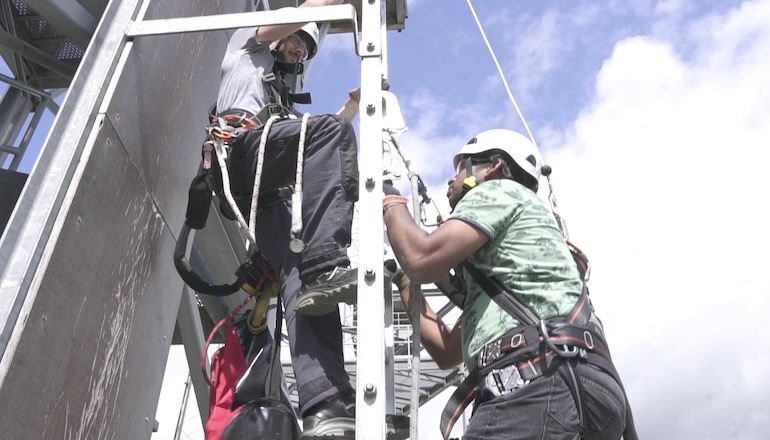
Nearly half a million workers must be trained to safely meet expansion of global wind market over next five years, according to the Global Wind Energy Council (GWEC).
New analysis from GWEC, Global Wind Organisation (GWO) and Renewables Consulting Group (RCG) found that 480,000 workers need to be trained to GWO standard to deliver onshore and offshore wind market forecasts safely from 2021-2025.
Global standardised training is “key to ensuring the health and safety of the workforce and safeguarding the wind industry’s sustainability and license to operate in the energy transition”, GWEC, GWO and RCG stated.
The analysis found these workers will need to be trained to construct, install, operate and maintain the world’s growing onshore and offshore wind fleet, and represents “only a fraction” of the job opportunities available in the growing wind industry.
Today, the GWO training market, considered the global standard for wind workforce training, has the capacity to support the training needs of 150,000 workers by the end of 2021 and 200,000 by the end of 2022.
Analysis in The Global Wind Workforce Outlook 2021-2025 forecasts the industry will need at least 280,000 more trained workers to install the anticipated 490GW of new wind power capacity coming online over the next five years.
Of the 480,000 GWO trained workers required worldwide, 308,000 will be deployed to construct and maintain onshore wind projects and 172,000 are needed for offshore wind.
Over 70% of the new global workforce training demand will come from the 10 markets analysed in the report, including: Brazil, China, Japan, India, Mexico, Morocco, Saudi Arabia, South Africa, the US and Vietnam.
GWEC CEO Ben Backwell said: “To meet this challenge, we need to prepare now for the workforce of the future, and this means training hundreds of thousands of workers across the world to be part of one of the fastest-growing industries.
“But we need to ensure this workforce is trained to the highest global standards to ensure the health and safety of all.”
The markets analysed in the report were selected for regional diversity, as well as spanning the largest onshore wind markets globally, high-growth markets for onshore and offshore wind, and emerging wind markets.
GWO CEO Jakob Lau Holst added: “There is a lot of talk about how many GWs of wind power we will need to achieve net zero, but there isn’t a lot of discussion about the workforce we will need to realise the ambitions on the ground.
“Hundreds of thousands of people across the world, even throughout the COVID-19 pandemic, work on the turbines that power our economies and protect our planet, and it is crucial that we keep these people safe.
“Having GWO safety training standards is one of the most efficient ways to make sure our workforce is staying safe and that we have the people we need to accelerate the global energy transition.”