


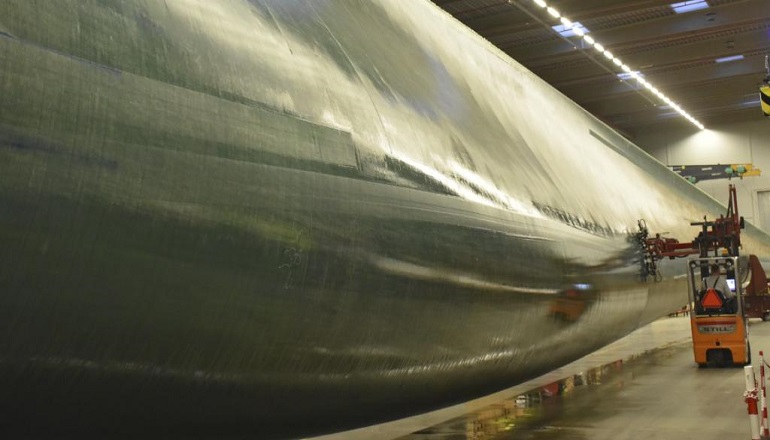
Siemens Gamesa has partnered with IBM Services to create a machine learning (ML) solution on Microsoft Azure to accelerate blade manufacturing.
The tool uses a laser grid to show exactly where to place each fibreglass layer with pinpoint accuracy, IBM said.
It involves multiple technologies, including computer vision, ML, edge computing and the Internet of Things (IoT).
IBM Services worked with Siemens Gamesa’s Digital Ventures Labs External Link (DVL) on the venture.
Siemens Gamesa senior product manager said Finn Mainstone said: “Everyone worked together seamlessly as we tested the solution on a real blade – and IBM even made changes to the code on the fly.
“The project was an undisputed success, and IBM is the perfect partner for Siemens Gamesa.”
Siemens Gamesa is now using the data-driven manufacturing solution on one of its production lines in Aalborg, Denmark.
The next phase will see Siemens Gamesa extend the solution to cover all its manufacturing lines in Aalborg, and then its factories in Le Havre, France and Hull in the UK.
The company is also exploring the idea of implementing the solution in all its factories around the world.
Mainstone said: “Each turbine blade is custom designed by our engineers to precise specifications, and any defects during the manufacturing process can result in complex, costly and time-consuming corrections.
“To avoid this situation, our teams see a laser grid displayed on top of each blade that shows them exactly where to place each fibreglass layer.
“Crucially, they can now get instant alerts if the solution detects any errors or abnormalities in the surface of the blade.
“Thanks to IoT-connected cameras in our factory and continuous analysis using machine learning models on the edge, all managed on Microsoft Azure, our technicians can place each blade layer with greater speed and accuracy.
“As a result, we are on course to reduce manufacturing error rates caused by misplaced material, which helps keep our production lines moving smoothly.
“In fact, once we roll the solution out globally, we will be better able to share best practices.
“This will reduce the learning curve for teams in our newly opened factories, such as Le Havre, France – enabling us to boost our throughput, accept more client orders, and bring the benefits of green energy to more people around the world.”