


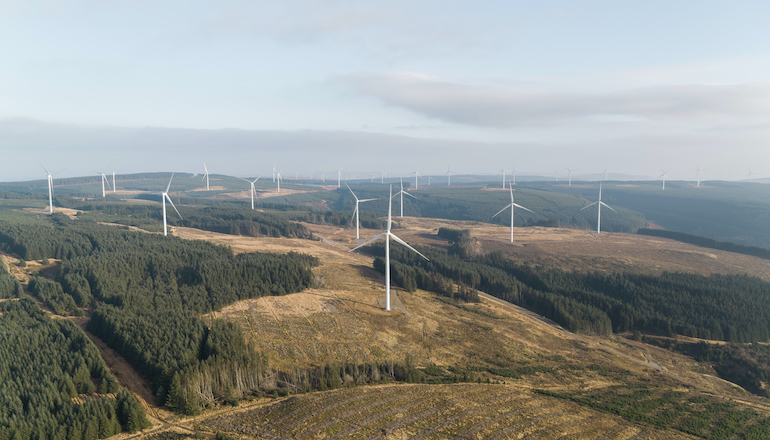
Scotland has seen the largest increase in renewable pipeline capacity in the past year of all regions across Great Britain, according to Cornwall Insight’s renewables pipeline tracker.
Using regions defined by distribution network operator (DNO) service areas and accounting for projects due to connect to the transmission network, central and southern Scotland and eastern England have seen the largest increase with 1003MW and 800MW of additional pipeline capacity added, respectively.
The tracker found most regions across Great Britain showed a net increase in total pipeline capacity between April 2020 and March 2021.
London was the only region to see a small net decrease in pipeline capacity of 5MW since the April 2020 report, with 26MW of energy from waste (EfW) incineration leaving the pipeline.
Cornwall Insight analyst Laura Woolsey said: “There is no one technology type driving the regional increases; however, certain technology types dominate specific regions.
“For example, Scotland has seen the largest increase in onshore wind, particularly in central and southern Scotland. Other areas have seen proportionally smaller changes in total capacity within the last year.
“Onshore wind is overwhelmingly located in Scotland likely due to a more supportive planning framework and wider factors such as wind speed conditions and land access.
“Although onshore wind dominates capacity in this region, high Transmission Network Use of System (TNUoS) costs have been highlighted as a potential barrier to development.”
Offshore wind also has large capacity levels in Scotland and in the east of England where several large-scale sites are expected to connect to the transmission network.
Central and southern England has seen the largest increases in solar photovoltaic (PV) capacity, which is more likely to connect at the distribution level.
Woolsey added: “However, battery capacity has changed more widely across GB, with east/south eastern regions and Scotland seeing the largest increases to the pipeline.
“Battery sites are often co-located with other generation, particularly with solar PV, with many applications being added to existing onshore wind and solar PV sites.”