


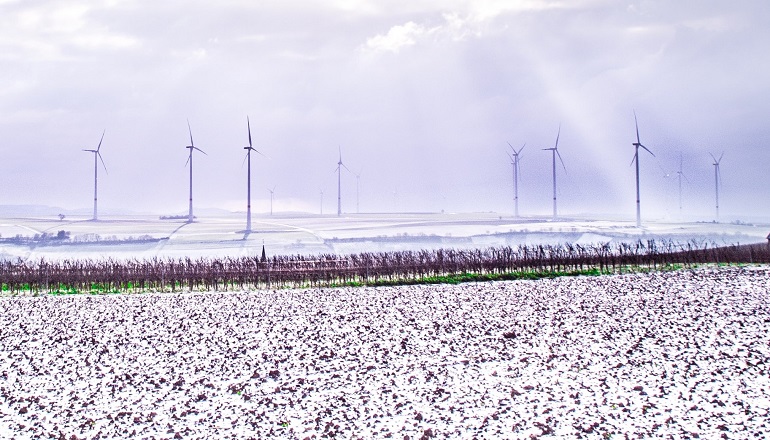
Renewables consultancy ArcVera has produced a study that reveals the recent bout of cold weather in Texas earlier this year led to over $4bn in financial losses for wind farms in the state.
The “ERCOT Market Cold Weather Failure 10-19 February 2021: Wind Energy Financial Losses and Corrective Actions” study points to shortcomings in the hedged financial structures, with “asymmetric price risk leading to significant losses for wind farm operators and gains for counterparties”.
The study is focused on wind farm outages reported by the Electric Reliability Council of Texas (ERCOT) grid operator for the period 14-19 February 2021, when the grid experienced extensive wind farm downtime, lost energy production, and high hub-settled electricity prices.
The study analysed the outage periods documented by ERCOT for 191 wind farms, with a nominal capacity of 21,888MW, of which 57% (12,495MW) is subject to a hedged financial structure.
Three repricing scenarios are evaluated using market pricing before the imposition of $9000 per megawatt-hour prices by ERCOT.
The “significant implications” for future wind farms and the Electric Reliability Council of Texas (ERCOT) wholesale market planning are described in the study.
The study set out to quantify the lost energy production and calculate the financial impact of the rare Texas winter weather event.
ArcVera Renewables CEO and report author Gregory Poulos said: “Given that the market demand was decreased by ERCOT with blackouts so that production balanced that reduced demand with market prices high but not near the $9000/MWh imposed value, we consider that the $9000/MWh ERCOT mandate could have imposed large, and quite possibly artificial, financial impacts (windfalls and losses) on wind energy power plant operators and investors.”
He said ERCOT “must now more stringently apply atmospheric science-based risk assessment, particularly concerning extreme weather operational scenarios”.
Poulos said renewable energy production is governed by the weather and peak electricity demand scenarios are also governed by weather, such as high and low-temperature events.
“As such, there is a clear need for restructuring electricity system resilience to account for weather-driven production and demand, concomitant with the pace of the transition to renewable energy-dominated production.”
The findings of the study show the lost energy production from wind farms, aggregating individual wind farm results, was 629,700 MWh with a financial impact of this lost production, whether the financial loss to the owner or gain by others, estimated at $4.18bn.
This represents an average financial impact on any project of $44.4m. For hedged projects, the financial impact of this lost proxy production is even greater, with an average financial impact of $45.4m, the study found.
The study draws three conclusions.
Firstly, hedged financial structures in ERCOT need to properly reflect realistic meteorological conditions, extreme weather stress tests, and, therefore, more realistic production assurances.
Hedged products need to “recalibrate their strike prices” to reflect the asymmetric risks presented by the availability of different resources during extreme electricity demand, ERCOT minimum and maximum prices, and market interventions by regulators.
Finally, wind farm owners and their hedge counterparties need to partner with turbine OEMs to develop reliable, cost-effective weatherization technologies to reduce the asymmetric risks from future icing events.