


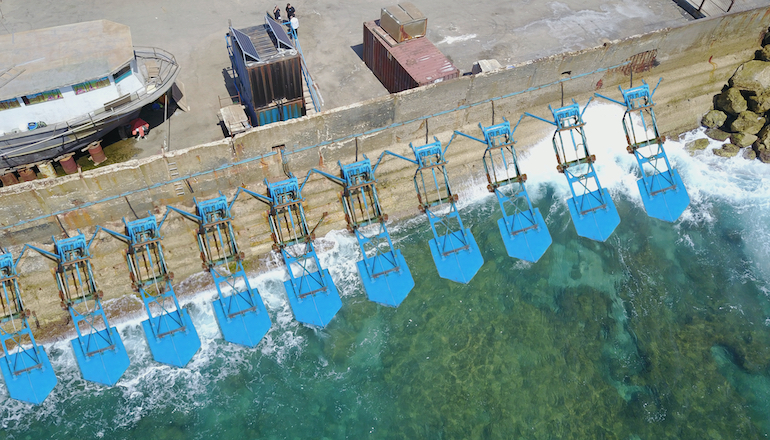
Swedish developer Eco Wave Power has secured the engineering coordination permit from the municipality of Tel-Aviv Jaffa needed for a 100kW wave energy project off Israel.
The permit is for the cement works and installation of 10 floaters for the EWP-EDF One wave energy project in the Port of Jaffa.
EWP-EDF One is being executed in collaboration with EDF Renewables IL with co-funding from the Israeli Energy Ministry.
Eco Wave Power said the permit allows it to proceed with the actual installation of the project in the seaside of the breakwater, which shall include cement works for the breakwater’s reinforcement and the installation of the floaters on 30 linear metres of a pre-existing breakwater within the port.
Each floater will have a surface area of 8.54 square metres, the company said.
All civil works were planned and will be supervised by Alex Gleizer, a civil engineer with 25 years of experience, executing projects for the Israeli Railway Company, the Israeli Air Force, and the Israeli Electric Company.
The works, which will be executed via a sub-contractor, are expected to be completed in the upcoming months.
Gleizer said: “I have taken part in multiple energy projects, such as a 495MW traditional power station in 2012 and a pumped storage hydroelectricity project in the Gilboa in Israel in 2017, but Eco Wave Power’s wave energy technology is definitely the most unique and innovative project that I have taken part in.
“I am very excited to take part in this project by supervising the execution of the civil works in a safe and reliable manner.”
Eco Wave Power founder and chief executive Inna Braverman said: “We are delighted to announce this milestone, which is a final engineering coordination permit that enables us to continue with the cement works and floaters’ installation portion of our works, and is bringing us one step closer to deploying our second grid-connected wave energy power station.
“Due to the onshore nature of the Eco Wave Power technology, the cement and floaters installation works will be straightforward and will not involve any ships, divers, underwater cables or underwater moorings, which are known to be extremely expensive and complex.
“All works will be performed from the land side, using standard equipment such as cranes, thus reinforcing the cost-effectiveness of the Eco Wave Power technology, in comparison to offshore solutions.”