


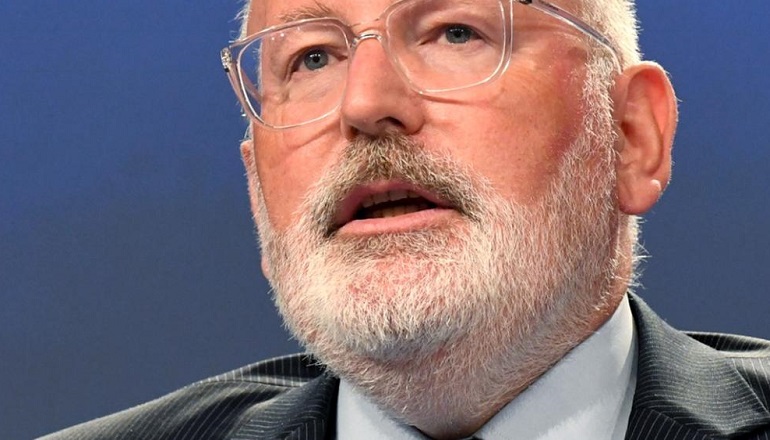
European Green Deal executive vice president Frans Timmermans said the EU has “all it needs” to deliver its €800bn 300GW offshore wind by 2050 ambition.
Speaking on the launch of the EU Strategy on Offshore Renewable Energy, Timmermans said: “With our vast sea basins and industrial leadership, the European Union has all that it needs to rise up to the challenge.
“Already, offshore renewable energy is a true European success story.
“We aim to turn it into an even greater opportunity for clean energy, high quality jobs, sustainable growth, and international competitiveness.”
The EU Strategy on Offshore Renewable Energy proposes to increase Europe’s offshore wind capacity from its current level of 12GW to at least 60GW by 2030 and eventually to 300GW by 2050.
The strategy is bolstered by a goal of 40GW of ocean energy and other emerging technologies such as floating wind and solar over the next 30 years.
The European Commission estimates that nearly €800bn will be needed between now and 2050 to deliver the strategy, which will require integrating offshore renewable energy development objectives in the National Maritime Spatial Plans.
Coastal states are due to submit these by March 2021.
The commission will also propose a framework under the revised TEN-E Regulation for long-term offshore grid planning, involving regulators and the member states in each sea basin.
To help “generate and unleash” this investment, the commission will provide a “clear and supportive” legal framework, including clarification of electricity market rules.
The commission will also ensure revisions of the State Aid guidelines on energy and environmental protection and of the Renewable Energy Directive will facilitate cost-effective deployment of renewable offshore energy.
Member states are encouraged to use the Recovery and Resilience Facility and work together with the European Investment Bank and other financial institutions to support investments in offshore energy through InvestEU.
Horizon Europe funds will be mobilised to support research and development, particularly in less mature technologies. Ensure a strengthened supply chain.
The strategy underlines the need to “improve manufacturing capacity and port infrastructure” and to increase the “appropriately skilled workforce to sustain higher installation rates”.
The commission plans to establish a dedicated platform on offshore renewables within the Clean Energy Industrial Forum to bring together all actors and address supply chain development.
Energy commissioner Kadri Simson said: “Europe is a world leader in offshore renewable energy and can become a powerhouse for its global development.
“We must step up our game by harnessing all the potential of offshore wind and by advancing other technologies such as wave, tidal and floating solar.
This strategy sets a clear direction and establishes a stable framework, which are crucial for public authorities, investors and developers in this sector.
“We need to boost the EU’s domestic production to achieve our climate targets, feed the growing electricity demand and support the economy in its post-Covid recovery.”
Environment, oceans and fisheries commissioner Virginijus Sinkevicius, said: “The strategy outlines offshore renewable energy can developed in combination with other human activities, such as fisheries, aquaculture or shipping, and in harmony with nature.
“The proposals will also allow us to protect biodiversity and to address possible socio-economic consequences for sectors relying on good health of marine ecosystems, thus promoting a sound coexistence within the maritime space,” Sinkevicius said.
To promote the scale-up of offshore energy capacity, the commission will encourage cross-border cooperation between member states on long term planning and deployment.