


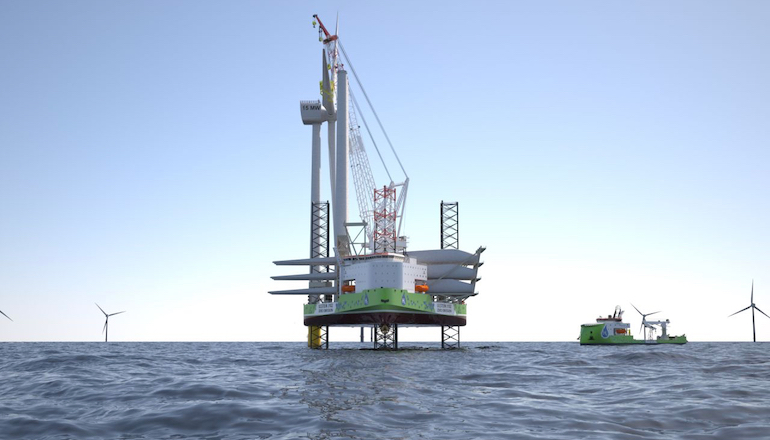
Norwegian company Ulstein has unveiled a second hydrogen hybrid design for the offshore wind industry.
The Ulstein J102 zero emission wind turbine installation vessel (WTIV) will be able to operate 75% of the time in zero emission mode.
The company said that by using readily available technology, the additional cost is limited to less than 5% of the total CAPEX.
Ulstein product manager Ko Stroo said: “We have carefully analysed the operational cycle of WTIVs and looked at the power demand in the various modes of operations.
“This analysis showed that about 75% of its time, a WTIV is in jacked-up position performing crane operations.
“Using a combination of a hydrogen fuel cell system and a relatively small battery energy storage system is then sufficient to meet the overall power demand on board and crane peak loads.”
The company’s has already designed one hydrogen powered vessel – the SX190.
The hydrogen hybrid system of the Ulstein J102 design has been developed in such a way, that future developments in hydrogen technology can easily be fitted into the vessel without major modifications, the company said.
Stroo said: “The limited availability of hydrogen bunker infrastructure in ports is often seen as a major hurdle.
“With our modular storage lay-out, we want to break the chicken and egg dilemma.
“It creates flexibility to operate the vessel worldwide, even when bunker infrastructure is not yet present.”