


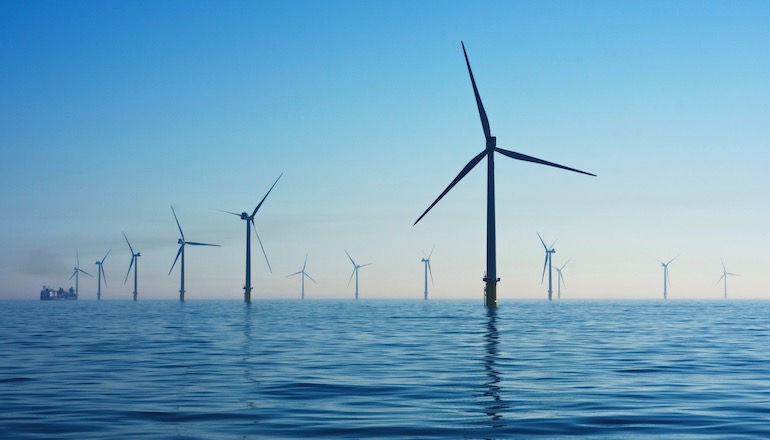
Offshore wind farm licensing should include more sustainable decommissioning requirements, according to a new study.
The report by a team of researchers at the University of Leeds found current practices rely on recycling, “sustainable incineration” or, in some countries, landfilling of material, entailing limited sustainability benefits.
Highlighting the need to embed circular economy in low carbon infrastructure decommissioning: The case of offshore wind, was led by Paul Jensen, an expert in low carbon development in the Faculty of the Environment at Leeds University.
The researchers said the offshore wind and wider renewables industry should embrace the idea of a circular economy, an approach that “lies at the heart of sustainability”.
This requires technology design to accommodate for equipment that can be repaired and maintained to extend its operational life.
Once it does reach the end of its service life, the approach allows for most components to be disassembled, reused, re-processed and recycled.
The university recently began a project with the Offshore Renewable Energy Catapult and the Department for International Trade to embed sustainable circular economy practices into the offshore wind sector.
Analysis in the study found that the industry’s decommissioning plans for offshore wind are “at best formulaic and at worst perfunctory and provide no value to the growing movement toward a circular economy”.
The continuing need for low-carbon infrastructure, creates “added urgency” for industry to develop sustainable approaches to resource management, the researchers argued in a paper published in the journal Sustainable Production and Consumption.
In the paper Jensen stated: “In a perfect world we would have in the region of ten years to innovate and scale up industrial solutions that can ensure sustainable and resource conserving solutions for offshore wind farms and many other low carbon technologies.
“Given the early stage in which many of the end-of-use solutions still are, that is not a lot of time.”
Anne Velenturf, a researcher in the university’s School of Civil Engineering, said low carbon infrastructure “risks falling into the same mistakes” as oil and gas and nuclear infrastructure decommissioning, resulting in significant losses of carbon savings.