


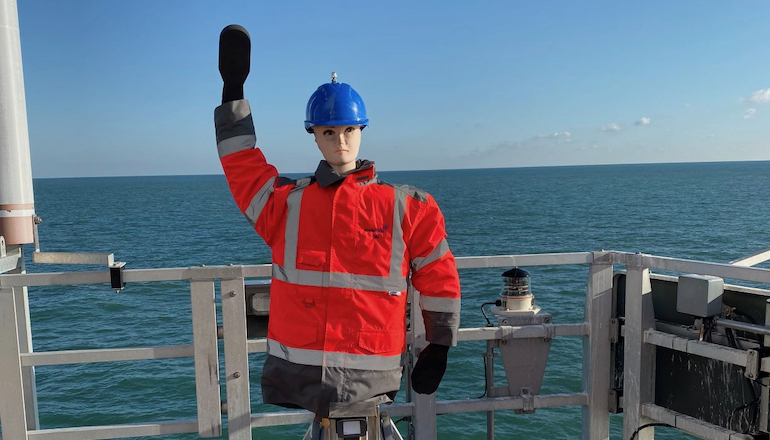
A so-called ‘scarecrow’ system designed to prevent the costly issue of seabird droppings on offshore wind farms has proved overwhelmingly successful in a year-long trial at RWE’s 353MW Galloper project off the east coast of England.
Seabird poop or ‘guano’ is a huge problem for the global offshore wind industry as it poses a serious health risk, due to its highly carcinogenic qualities, and is extremely expensive and unpleasant to remove.
The Scaretech system was installed on the substation at Galloper, 27km off the Suffolk coast, in July 2019 to address the problem.
In the last 12 months, Scaretech, has reduced guano on the structure from approximately 50-60% coverage to virtually nothing.
Galloper interim operations and maintenance manager Kieron Drew said: “There is an abundance of seabass around our Galloper site, which attracts large numbers of seabirds.
“These in turn generate significant quantities of guano, which poses an unpleasant health and safety hazard for us.
“We were looking for a solution and, after considering more expensive options, decided to trial Scaretech.
“This is a new innovation for the wind industry and it certainly worked for us.
“Once we installed the Scaretch device, we saw dramatic reductions in the amount of guano. In fact, the problem is now almost non-existent.
“Scaretech is extremely robust, maintenance-free and solar powered so after installation we were able to just forget about it.
“It’s been a fantastic asset and has saved us a considerable amount in clean-up costs and technician time.”
This is the second time Scaretech’s guano solution has been successfully trialled, with an initial four-week pilot also showing strong results.
The Scaretech device is based on a traditional scarecrow concept – used successfully for centuries to keep birds off crops – and adapted for the harsh offshore environment of a wind farm or oil platform.
It is designed to look like an offshore wind worker in full protective clothing, Scaretech is manufactured from steel, flexible foam and PVC and powered by solar panels.
The device is securely fixed to the offshore structure so it can operate in extreme weather conditions.
Scaretech also emits sporadic loud noises and high intensity strobe lights which deters seabirds from landing on the structure.
It was developed by offshore client representative Terry Christie.
Christie and his team were heading home on a vessel when someone noticed a familiar high visibility PPE colour on the now distant offshore wind turbine they’d been working on.
Thinking someone had been left behind, the vessel returned to the wind turbine to find it was a forgotten high-vis protective jacket, not a man.
The area around the abandoned jacket was the only place seagulls weren’t landing within the proximity.
Christie, along with his colleague, offshore engineer, Paddy Armstrong, decided to develop the concept.
He has now joined forces with wind service company, CPower Energy, to promote Scaretech to the global offshore market.
Christie said: “This trial with Galloper wind farm is a game-changer for us and shows once and for all that Scaretech is an extremely effective, long-standing solution for the guano problem.
“We knew of the systems’ potential from our previous trial but this data now proves that just one Scaretech can protect an area as large as a substation or helideck from guano for 12 months and longer.
” Over time, the birds never become accustomed to the device and simply stay away from it.
“This is fantastic news for the offshore industry. Any health and safety matrix highlights the need to eliminate hazards if at all possible, and Scaretech certainly does this for guano.
“We’ve taken the simple bird deterrent of a scarecrow- tested over hundreds of years – and updated it with the latest, state-of-the-art technology to enable it to withstand the extreme weather conditions offshore.
“Scaretech works beyond everyone’s expectations and we now plan to launch a low-cost monthly rental option to enable the offshore sector to benefit from this proven solution.”