


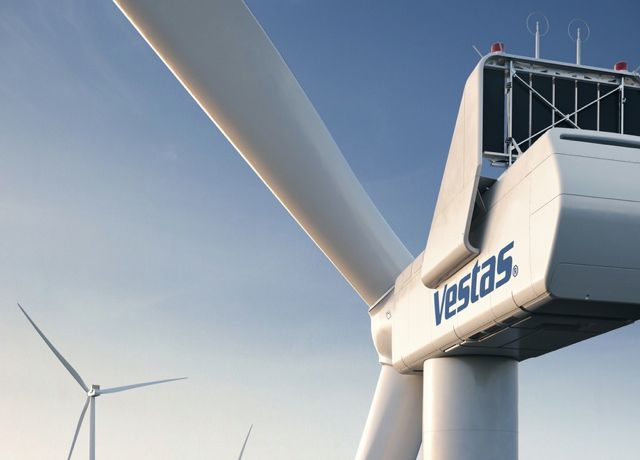
Vestas has retained top spot as the leading global turbine maker, according to Bloomberg New Energy Finance (BNEF).
Of the top 10 onshore turbine makers, Vestas, however, suffered the biggest slippage in its market share, down four percentage points to 18%, as its competitors gained ground.
The figures draw on BNEF’s global database of wind projects and extensive information from the industry, which shows that developers commissioned almost 61GW of wind in 2019.
Siemens Gamesa moved up to second place, from fourth.
Four manufacturers accounted for 55% of turbines installed. After Vestas and Siemens Gamesa, China’s Goldwind took third place and US turbine maker GE was fourth.
With Envision in fifth place, the top five remains unchanged. However, according to BNEF, a “strong year” for Chinese installations pushed up Ming Yang, Windey and Dongfang Electric to sixth, seventh and ninth, respectively.
Compared with 50GW in 2019, last year saw an 11GW rise in turbine installations, with 88% comprising onshore installations.
Total onshore wind additions in 2019 were 13.3GW in the Americas, 9GW in Europe and 0.5MW in Africa and the Middle East, while Asia Pacific accounted for 30.4GW.
Nearly half of all new megawatts installed in the US were from GE, enabling it to seize the top spot in its home market from Vestas.
GE outperformed its rival by commissioning 40% more than it had in 2018, while Vestas’ installation total was stable.
Siemens Gamesa enjoyed the biggest bounce of any of the players in the US, tripling its 2018 numbers and taking over the third place from Nordex.
“Underpinning each of the leading onshore players is a strong presence in either the US or China,” said BNEF wind analyst Oliver Metcalfe.
Enercon and Senvion saw commissioned capacity “plummet” as Germany’s onshore wind market collapsed due to a shortage of available sites, litigation and drawn-out lead times for projects.
Suzlon suffered a similar fate in India, where project execution challenges resulted in installations falling short of expectations.
Metcalfe said: “2020 is set to be another strong year for installations in China and the US, as developers rush to build before subsidies lapse, but uncertainty post-2020 could expose some bigger players unless they diversify to new growth markets,” Metcalfe said.
According to BNEF the share of turbines installed offshore is growing, up four percentage points to 12%.
Siemens Gamesa’s offshore installations in European waters “blew its competition away”. The company retains the number one position in the offshore wind market after more than doubling its installations compared with 2018. The company commissioned almost two gigawatts in the UK alone, including the 1.2GW Hornsea Project One.
BNEF wind research head Tom Harries said: “This bumper year for offshore wind is just the start. If you look past a likely blip in 2020, installations are set to accelerate, breaking the 10GW-a-year barrier in 2023.
“This growth outlook has led to intense competition between turbine makers. At the moment, the advantage lies with the manufacturer selling the most powerful turbine. Industrialising the production of a slightly smaller turbine through higher volumes could lower costs and prices.
“The opportunities for turbine makers to offset lower prices with long-term maintenance contracts is less clear than it is in onshore wind.”