


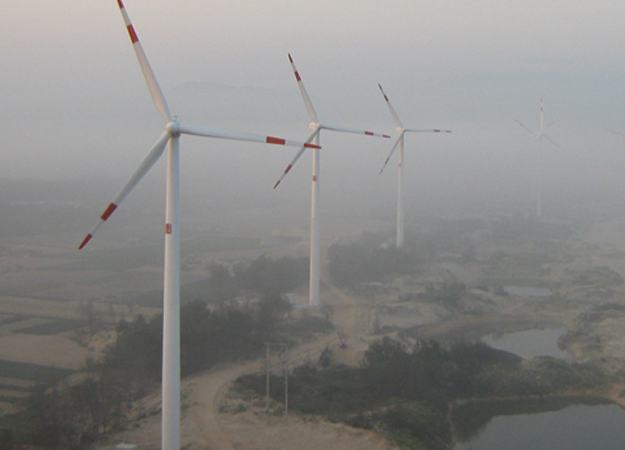
Production delays, as a result of the coronavirus outbreak (COVID-19), could cause a 10% to 50% decrease in wind turbine installations in China in 2020, according to Wood Mackenzie.
The COVID-19 outbreak has brought much of China’s wind turbine component production to a “standstill” in recent weeks, the analyst stated. Though there is limited production capacity in Hubei province, quarantine measures and travel restrictions will “impact an already tight supply situation” for key components.
According to Wood Mackenzie this is “bad news” for key wind markets such as China and the US where developers are rushing to complete projects by end of the year to remain eligible for government subsidies.
Wood Mackenzie senior consultant Xiaoyang Li said: “Due to an already tight supply of key components such as turbine blades and main bearings before the COVID-19 outbreak, first-quarter production delays have already reduced annual output of those components by about 10%.
“Components without pre-existing bottlenecks, such as generators and converters, should be able to recover from first quarter delays if the outbreak is brought under control in the next few months”.
According to Li, in a “best-case” scenario, the epidemic is contained and production resumes by the end of March. In a bear-case, the epidemic could “continue to impact” the supply chain well into the middle of the year.
“Based on these two possibilities, we estimate production delays across the wind turbine supply chain will result in a 10% to 50% decrease in 2020 wind installations in China, compared to our fourth quarter 2019 wind power outlook, which was at 28GW capacity,” he added.
For non-China, Asia Pacific markets, the direct impact of COVID-19 is minimal based on the limited number of reported cases and extreme containment measures taken to limit the spread of the virus.
These wind markets will need to lean on their domestic supply chains or imports from other low-cost regions such as India, Vietnam, and Southern Europe, said Wood Mackenzie.
The greatest concern for markets outside of China lies in the US, which is already struggling with a myriad of supply bottlenecks. Some 6GW of installations targeting 2020 commercial operation dates were identified as at-risk before the outbreak, requiring US Internal Revenue Service exemptions to maintain access to 100% value of the production tax credit. This number is now likely to grow.