


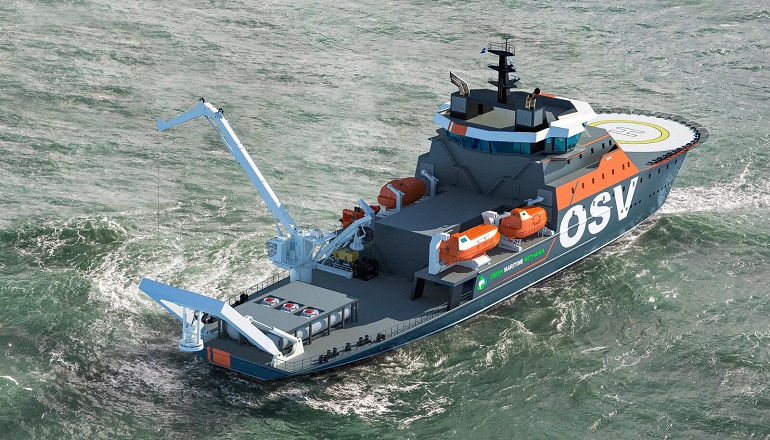
Damen has developed a new vessel design for deployment in offshore wind and other ocean-based energy sectors.
The offshore support vessel (OSV) 9020 vessel features a stable platform, low carbon emissions and flexibility to add mission-specific tools, following feedback from different operators.
Damen design and proposal engineer Mark Couwenberg said: “We were approached by several different operators at the same time, all looking for slightly different offshore capabilities, but similar enough that their requirements could be met with a conceptual standard platform.
“The thinking behind the OSV 9020 is very much in line with the Damen philosophy of shipbuilding in series; it’s a standard product, as a result drawing upon proven technology, that can be tailored to individual requirements via modularisation.”
The vessel can be fitted with a moonpool-deployed saturation dive system to allow diving operations and can also act as a submarine rescue vessel, when submarine rescue gear is placed on deck.
The OSV 9020 provides living space for up to 120 persons on board. Interior design is designed to ensure those on board will quickly feel at home, with lots of possibilities to personalise their stay on board, said Damen.
“There has been a lot of consideration to make sure the accommodation is both functional and comfortable. For example, care has been taken to ensure proper on board logistics, so that daily routines are as efficient as possible and that working areas are separated from living space,” Couwenberg said.
A helicopter deck is integrated in the design, further increasing the vessel flexibility.
The vessel is primarily designed to operate on dynamic positioning mode, with the complete hull, superstructure and thruster layout is designed for DP.
The vessel profile ensures low wind catch. The four identical azimuthing thrusters are arranged symmetrically: two on the stern and two on the bow. This ensures maximum station-keeping performance while avoiding high noise levels in the accommodation.
The layout also results in lower maintenance costs, lower fuel consumption and less total installed power.
The diesel generators are supported by a battery pack to reduce fuel consumption and emissions.
The vessel can optionally be delivered to operate on green methanol, produced from biological waste streams to reduce well-to-propeller carbon dioxide emissions by approximately 70%.