


Pakistan’s government has agreed deals with project developers for 11 wind farms totalling 560MW in the Asian country.
The country’s Alternative Energy Development Board, which was set up in 2003 to facilitate clean power growth in Pakistan, established 11 implementation agreements and guarantee direct agreements with the independent power producers.
Six of the 11 projects will be financed by the International Finance Corporation (IFC), the private sector arm of the World Bank.
The so-called super-six projects will have a combined capacity of 310MW and represent a total investment of $450m, IFC said.
IFC is providing a financing package of $320m, comprising $86m from its own account and $234m mobilized from other lenders, which include Deutsche Investitions- und Entwicklungsgesellschaft and local banks Bank Alfalah, Bank Al Habib and Meezan Bank.
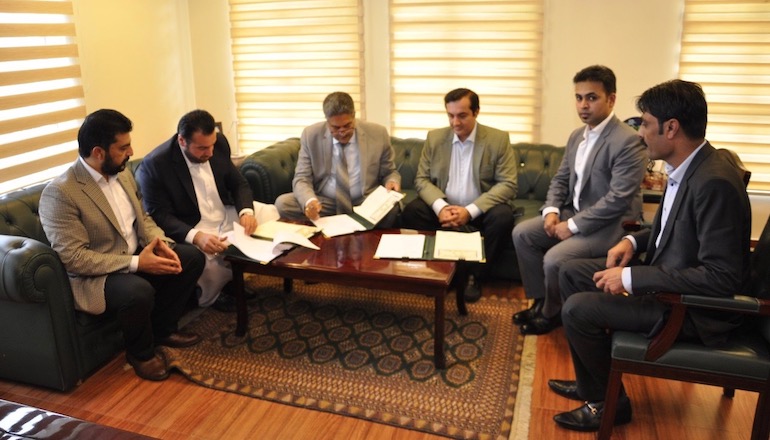
The financing agreements were signed today by IFC senior manager Nadeem Siddiqui and private sector power developers at a special ceremony witnessed by Pakistan Prime Minister Imran Khan and Federal Minister for Energy Omar Ayub.
The super-six will be built in the Jhimpir wind corridor in Sindh province and will generate more than 1000 gigawatt-hours of electricity a year.
They are being developed by local companies ACT Group, Artistic Milliners, Din Group, Gul Ahmed Group and Younus Brothers Group.
Ayub said: “The government is aiming to increase the non-hydro renewable energy share in the overall generation mix from 4% to 20% by 2025 and it is welcoming to see Pakistan’s local private sector behind these super-six wind projects, supporting the government’s long-term objective to see more wind and solar in the country’s energy mix.”
IFC vice president for Asia and Pacific Nena Stoiljkovic said: “This additional clean power will help meet growing demand, reduce the average cost of electricity, and improve both reliability and security of supply.
“We hope this will send a strong signal to the private sector that the renewable energy market in Pakistan is viable and sustainable, as well as beneficial to the Pakistani people.”