


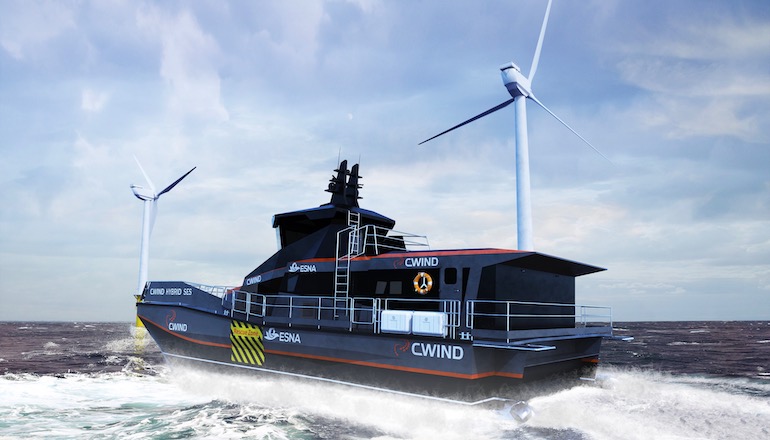
Orsted is to charter a hybrid powered surface effect ship (SES) from CWind from mid-2020 as a crew transfer vessel (CTV) at the 752MW Borssele 1&2 offshore wind farm off the Dutch coast.
The agreement covers an initial three-year period with options available for a further two years.
The hybrid SES CTV will operate from the Dutch port of Vlissingen.
CWind said the development of the vessel for use as a CTV is in response to an industry-wide push to develop and deploy innovative technologies that reduce carbon dioxide emissions, while cost effectively servicing wind farms located further offshore.
The vessel is powered through a combination of electric and diesel propulsion which, when combined with the surface effect hull form and heave compensation technology, is able to operate in sea states of up to two metres Hs, while decreasing fuel burn and CO2, the company said.
CWind developed the vessel in partnership with ESNA, a ship design company based in Kristiansand, Norway.
The vessel will be built by UK boat builder Wight Shipyard Company.
CWind managing director of group business operations Ian Bryan said: “We are delighted to announce the agreement with Orsted, and look forward to delivering the world’s first hybrid SES for them in 2020.
“Our development of the vessel has been driven by listening to the market and our customers who want a greener, safer and more efficient crew transfer vessel to support their commercial and green objectives.”
ESNA co-founder Trygve Espeland said: “The vessel design will accommodate further developments in hybrid propulsion and battery technology, ensuring it has the capability of being developed into a totally carbon-free solution in the future.”