


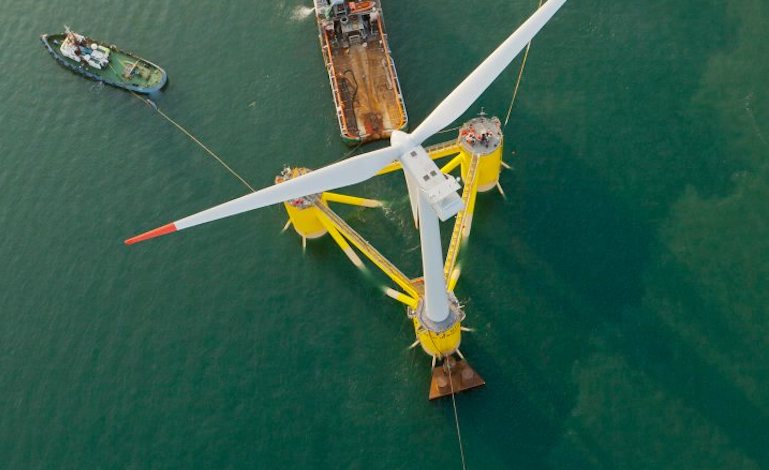
A consortium led by Principle Power has been awarded a grant of just under $4m from the US Department of Energy’s Advanced Research Projects Agency-Energy (ARPA-E) for a floating wind ‘digital twin’ project.
In the $3.6m DIGIFLOAT initiative, the consortium of private companies and research institutes will develop, validate and operate the world’s first digital twin software tailored specifically for floating offshore wind.
The digital twin model will be a real-time, high-fidelity numerical representation of the WindFloat Atlantic (WFA) project, which is being developed off the coast of northern Portugal, in Europe.
Principle Power chief executive Joao Metelo said: “We are at the beginning of an exciting new era for floating wind and proud to be part of a team that is developing digital innovations that will help accelerate the deployment of the technology around the world.
“This grant will be instrumental in ensuring that the game-changing WindFloat technology can benefit from innovations that achieve greater efficiency and design optimisation, which will make it increasingly competitive in terms of cost and performance.”
The project consortium is composed of Principle Power, Akselos, the American Bureau of Shipping, the University of Washington-Applied Physics Laboratory, the University of California Berkeley, US Naval Surface Warfare Center, Carderock Division and EDP Renewables North America Offshore.
Principle Power R&D lead Sam Kanner said: “Insights from the digital twin model we build and validate will give designers, operators, and other stakeholders greater understanding into WFA’s performance and operation, leading to less downtime, lower operational costs and better predictive capabilities.
“Using the software on a full-scale floating offshore wind turbine in a dynamic, offshore environment enables us to create superior, next-generation designs by closing the design feedback loop on a real-world project.”
The funding is part of the Aerodynamic Turbines Lighter and Afloat with Nautical Technologies and Integrated Servo-control (ATLANTIS) programme, created by the Department of Energy to develop new floating offshore wind turbines by maximising their rotor-area-to-total-weight ratio while maintaining or ideally increasing turbine generation efficiency.
The programme is also addressing the creation of a new generation of computer tools to facilitate floating offshore wind turbine design and collection of real data from full and lab-scale experiments to validate designs and computer tools.