


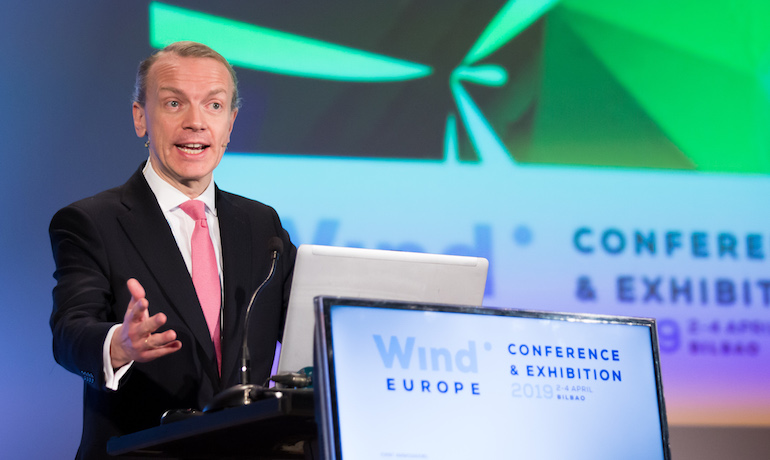
Public support for wind energy cannot be taken for granted, according to WindEurope chief executive Giles Dickson.
Dickson, who was speaking at the 24th World Energy Congress in Abu Dhabi this week, said that the societal benefits of wind energy must be promoted more, while efforts to involve communities in wind farms and allow them to share the benefits also need to be increased.
Speaking on the panel, ‘Communities and the social license to operate’, Dickson said that “license to operate” means a license to operate from government and society at large and also a license to operate from the local community where the industry wants to build wind farms.
“How we reduce carbon dioxide; how we reduce energy imports because we use the local wind resource; how we support jobs – over 300,000 in Europe – and how our industry earns €8bn exports for the EU economy. It’s a good story. And people get it. Opinion polls show 75-80% of Europeans want more wind,” he said.
Dickson also said that the wind industry needs to go further than promoting the local economic benefits, such as local jobs, and taxes wind farms pay to the local municipalities.
He said: “We need to involve the local community directly in our projects and allow them to profit directly from them.
“Essentially, this is about participation. Project developers need to engage the community from the very start, when drawing up the initial plans for a wind project. This process needs to be transparent and inclusive.”
Dickson also underlined that how the industry communicates is just as important as what it communicates.
“This process is not a public consultation, where you’re trying to get people to agree with a conclusion you’ve already reached. It’s a learning exercise where you allow residents to assess the pros and cons of a project and you learn what their needs are.”
Dickson urged project developers to be sensitive to people’s sense of place and attachment and their emotional connection to the landscape and environment.
He stressed that it is important to explain how people will benefit economically and offer them a model for that – not just in terms of jobs, but in terms of the whole community. “‘Benefit’ does not mean ‘compensation’ or ‘inducement.’ It’s about reinvestment of revenues from the wind farm to serve the community.”
Dickson highlighted several models for this, including shared ownership and cooperatives. “It doesn’t matter which model you use,” he said. “So long as it’s based on partnership with the community and has buy-in from the key community groups and the local government. Crucially, it needs to be based on common interest.”