


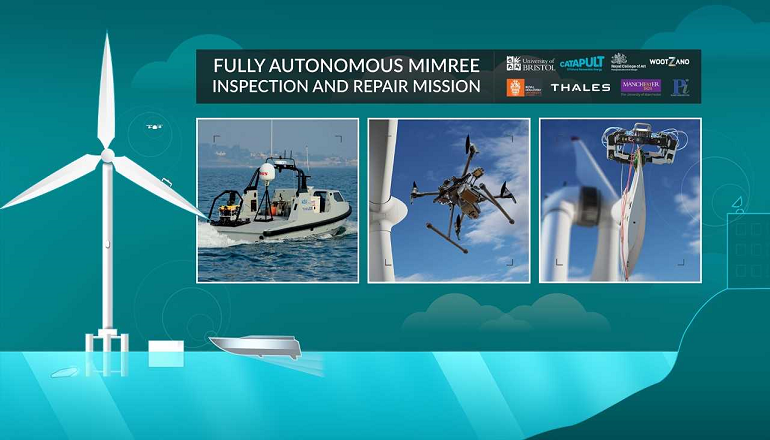
A new £4m project in the UK aims to develop the technology for carrying out autonomous robotic inspection and repair at offshore wind farms, which could save a project an average of £26m over its lifetime.
The Innovate UK-funded Multi-Platform Inspection, Maintenance and Repair in Extreme Environments (MIMRee) will run for two years, with the aim of proving that offshore wind operations and maintenance missions can be conducted by autonomous vessels, aerial vehicles and crawling robots.
The project will pool expertise from the fields of robotics, non-destructive testing, artificial intelligence, space mission planning, marine and aerial engineering, plus nanobiotechnology.
Eight industry and academic partners will work together on MIMRee, which will build on their own existing innovations.
UK company Plant Integrity will lead the consortium and the Offshore Renewable Energy (ORE) Catapult will provide industry insight, engineering expertise and access to facilities to test and demonstrate the MIMRee system.
Inspection and repair missions on turbine blades are typically performed by rope-access technicians, often working in extreme conditions and during restricted weather windows.
The length of turbine downtime, and hence lost energy production, using this approach is high, the initiative said.
In addition, the daily use of crew transfer vessels makes up a significant proportion of a wind farm’s operation and maintenance costs.
Thales’ Halcyon autonomous vessel will be deployed for MIMRee, along with a drone system under development by the University of Bristol’s Tom Richardson, and a six-legged crawling repair robot BladeBUG, invented by entrepreneur Chris Cieslak.
“The core innovation challenge will be to bring these units into one team capable of planning, communicating, sharing data and working together on a complex chain of tasks,” said ORE Catapult.
The University of Manchester’s Simon Watson will lead development of a system for transporting, deploying and retrieving the blade crawler.
Sara Bernardini of Royal Holloway University of London will lead creation of the human-machine interface that will allow personnel located onshore to analyse the data transmitted by MIMRee and intervene as necessary.
Bernardini said: “We will be working closely with a group of offshore wind technicians to create personas for the robots and map the tasks that will turn a human-led mission into an autonomous operation.
“Testing and consultation with technicians will be crucial to designing the interface for remote monitoring and intervention and understanding how to deal with the unexpected in a mission.”
On-board drones will conduct visual and hyperspectral imaging inspection of the blades and transport crawling robots on to the blade to effect repairs using an innovative robotic arm for resurfacing the blades.
These will be created bespoke by Sina Sareh’s team at the Royal College of Art Robotics Laboratory.
An electronic skin, developed by UK start-up Wootzano, will ‘feel’ the surface and collect a deeper level of data on the blade surface structure.
Plant Integrity principal project leader Martin Bourton added: “Some of the technologies are more fully-developed, such as the autonomous vessel, but robotics is at a more experimental stage.
“While the focus is on solving vital problems for the offshore wind industry, we’d expect to see a lot more insights and applications emerging as we test different combinations of mechanics, sensors and robotic intelligence.”
ORE Catapult operational performance director Chris Hill said: “Reducing the use of crew transfer vessels is an imperative for the offshore wind industry, as it will positively impact health and safety, help push down cost and combine the UK’s competitive advantage in operating offshore renewable energy plant with its world-leading robotics sector.”