


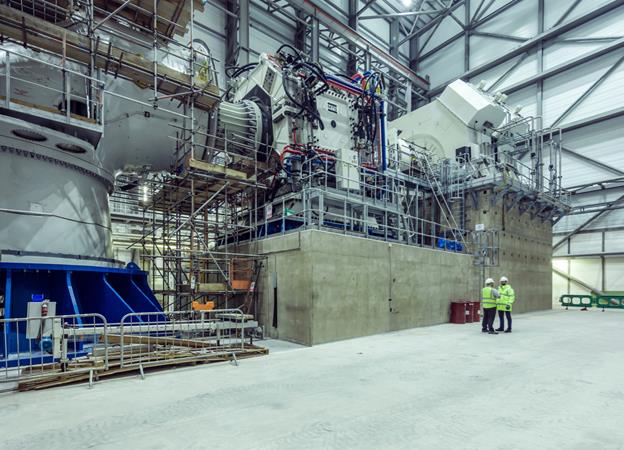
The Offshore Renewable Energy Catapult is partnering with the University of Sheffield to carry out research on offshore wind turbine powertrains.
The University will contribute at least £1.7m over five years to the project, while £700,000 will come form the Catapult.
Collectively the contributions will support 12 PhDs, Postdoctoral Research Associates and access to the University’s extensive testing facilities in addition to ORE Catapult’s 1MW, 3MW and 15MW (pictured) test assets at its National Renewable Energy Centre in Blyth.
GE Renewable Energy will also contribute £500,000 over a four-year programme supporting a number of research projects.
The Powertrain Research Hub will support the development of future technologies for larger turbines and research solutions for improving reliability and availability.
It aims to improve reliability and advance test methodologies and monitoring and prognostic technologies.
The hub will also develop next generation powertrain components for larger sized wind turbines.
Research will also focus on minimising human interventions throughout the life of the wind turbine.
ORE Catapult head of strategic research Paul McKeever said: “With industry moving towards larger wind turbines, we have an opportunity to significantly contribute to reducing the cost of turbine technology.
“It is essential to maximise this opportunity in a number of key areas including the challenge of improving powertrain component reliability and availability.
“By developing the next generation of powertrain components, and improving their lifespan, we can significantly reduce the related operations and maintenance costs and subsequently minimise the number of human interventions for potentially dangerous turbine repair work at sea.”
University of Sheffield scientific director David Stone said: “The University of Sheffield sees working with ORE Catapult as a fantastic opportunity to apply its cutting-edge research ideas to support the rapidly expanding field of green energy generation solutions.
“The synergies brought about by the Powertrain Research Hub will not only bring benefits for the University and the offshore wind industrial sector, but consumers as a whole through higher reliability, lower cost electricity generation.”
GE Renewable Energy offshore wind chief technology officer Vincent Schellings said: “The goals of the Powertrain Research Hub are aligned with our Stay Ashore! program announced at the end of last year.
“This academic collaboration will give us access to different insights, that will ultimately help us to achieve our goal of minimising the time spent at sea, which is a key element of reducing the cost of electricity for our customers.”