


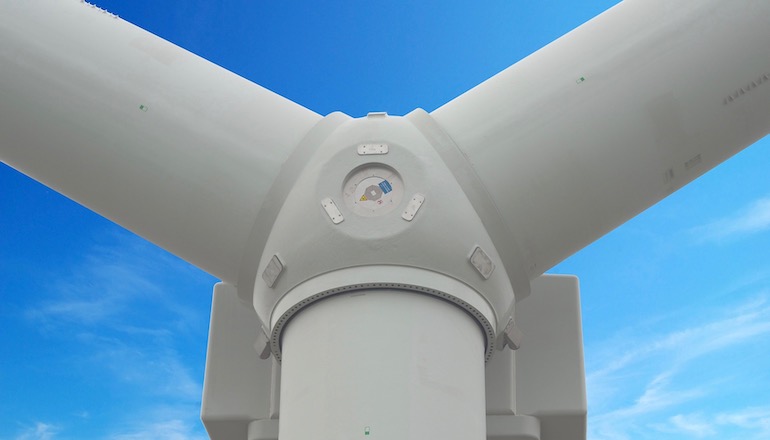
GE Renewable Energy has contracted Fraunhofer Institute for Wind Energy Systems in Germany to test the machine head of its new 5MW Cypress onshore wind turbine platform.
Tests will start in August and last for one year.
They aim to validate the capability of the technology in everyday operating environments, as well as extreme conditions.
GE Renewable Energy chief executive onshore wind for Europe and SSA Peter Wells said: “We chose to test our Cypress platform at IWES Fraunhofer so that we can accelerate the validation of the drive train integrated within the machine head in the most realistic way possible.
“Fraunhofer has the extensive experience and best-in-class technology that will enable us to validate our models and drive this platform forward while ensuring our products in the field perform as promised to our customers.”
Fraunhofer IWES managing director Andreas Reuter said: “Testing a drive train under laboratory conditions provides a thorough understanding of the mechanical and electrical system behaviour, leads to a substantial reduction of the prototype field-testing period, and, ultimately, provides a more reliable product to the customer. It will clearly be a standard in the future advanced turbine design process.”
Meanwhile, GE Renewable Energy has launched a new operation centre in Barcelona capable of monitoring over 2000 turbines.
The new centre brings the total number of onshore and offshore wind, solar and energy storage units monitored by the company around the world to more than 15,000.
Barcelona is the fourth centre of its kind to be opened by GE, with the others located in Schenectady in New York, Salzbergen in Germany and Bangalore, India.
The new centre will cover all existing turbine types and models and future platforms, including the new Cypress onshore turbine.
GE general manager for onshore wind digital services in Europe and SSA Robin Goodman said: “Our objective is to maximise the number of remote operations we can perform, in order to give our customers in South Europe a quicker response while minimising the need to physically visit the sites and the associated costs.
“This translates to positive economic results based on a more efficient predictive maintenance approach.”