


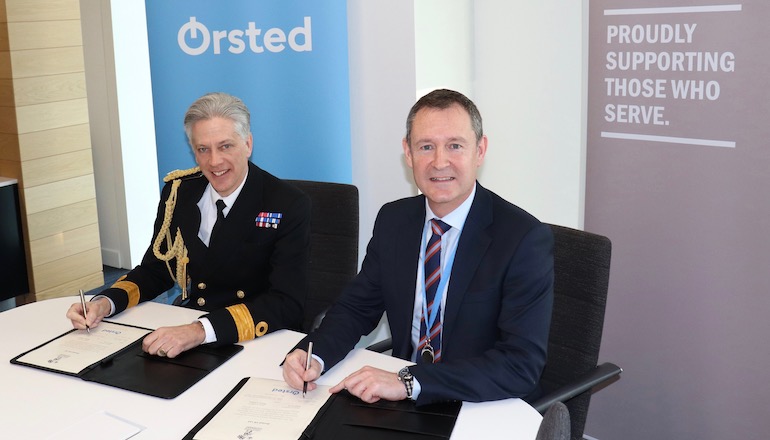
Orsted has teamed up with the UK armed forces in order to support the employment of veterans in the offshore wind industry.
The Danish energy giant has signed an Armed Forces Covenant that highlights offshore wind as a “forces-friendly” industry and will work with the Career Transition Partnership to develop a “tailored employment pathway for service leavers”.
Orsted will also offer flexibility in granting leave for service spouses and partners before, during and after a deployment wherever possible, as well as supporting employees who choose to be members of the reserve forces.
Many service veterans are already working on projects both offshore and onshore across the UK, Orsted said.
The covenant is a way to formalise the company’s pledge to ensure that those who serve or have served in the armed forces, and their families are treated with fairness, it added.
Orsted UK managing director Matthew Wright (pictured right) said: “At Orsted, we have refined our recruitment processes to ensure that we attract and retain new talent from a wide range of sources, as well as supporting and employing people in the communities where we develop and operate our projects.
“In our experience, service veterans possess many transferable skills and qualities which have led to a successful transition to careers in the offshore wind industry.
“We are therefore delighted to formalise our pledge of support to those who serve or have served in the armed forces with the signing of this covenant.”
Royal Navy commodore David Elford (pictured left) said: “At its heart, the covenant commits its signatories to do what they can to ensure that members of the Armed Forces – be they regulars, reserves or cadet force adult volunteers – and their families are not disadvantaged as a result of their service.
“For a company such as Orsted to sign the covenant and its associated pledges sends an important message, both inside and outside the company, that the armed forces are respected and valued.”
Former Royal Navy engineer Ash Hedges started at Orsted as a wind turbine technician and progressed to become deputy operations manager at the Westermost Rough offshore wind farm.
Hedges said: “I would definitely say my career in renewable energy would not have happened if not for my military beginning. The life skill and experience I have at 34 years old is a credit to my training and the Royal Navy.
“The experience of working in a high-pressure environment, with huge responsibility and living with your colleague’s day in day out really set me up for my current role.”
Burbo Bank turbine technician Stewart Brown was previously with the Royal Engineers for nine years.
He said: “I think there are a lot of qualities and skills that translate really well to offshore wind industry – discipline, team work, flexibility and integrity. The training in the armed forces is done to a very high level, so employees know that potential candidates are generally a very high standard.”