


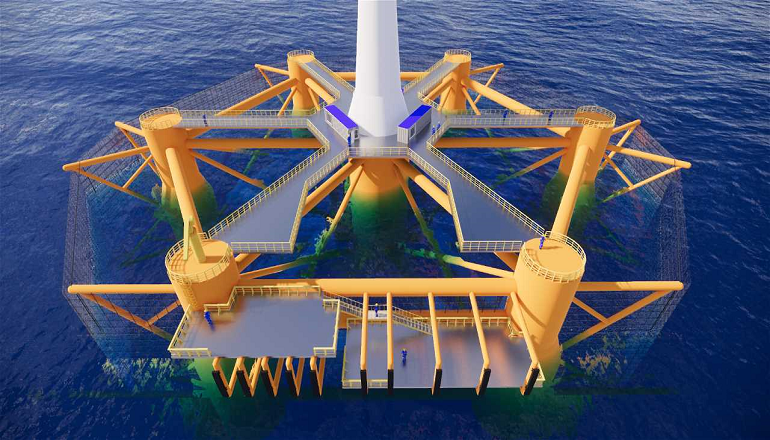
A recently concluded project exploring multi-use floating offshore platforms has identified several deployment concepts suitable for piloting, including offshore wind, aquaculture, security and surveillance.
The 15-month Offshore Platform for Energy Competitiveness (OPEC) feasibility project was set up to explore use of large offshore floating platforms to support various combinations of revenue generating applications.
OPEC comprises a large floating structure, made from reinforced concrete modules that are designed to support multiple wind and wave devices and aquaculture facilities.
Sharing foundation costs across multiple facilities would help to reduce capital costs, the study said.
OPEC identified several deployment cases most suitable for future investment.
These include integration of offshore wind power generation and shellfish farming.
Innovate UK has supported the project. Other participants include the Offshore Renewable Energy Catapult, Stellenbosch University in South Africa, marine contractor Houlder Eng and UK marine civil engineers Beckett Rankine.
The consortium suggests wind-plus-aquaculture OPEC platforms could bring socio-economic value to small developing island states.
According to the OPEC consortium next steps needed to develop such a platform require partnering with existing floating wind developers to integrate aquaculture production, capable of offering a worthwhile revenue stream but without having a major impact on platform cost.
Although the concepts identified in the initial feasibility study remain some way from commercial deployment, OPEC’s participants believe the project has helped highlight market potential for the mixed use platform, which could provide opportunities for a range of companies along the value chain supporting the engineering, construction, installation, operation and decommissioning of such platforms.
Options are being explored to fund a follow-up project to look at the detailed engineering required for two pilot multi-use platforms, one in South Africa and one in the UK.
In addition, the project highlighted two further development possibilities which merit investigation: the replacement of conventional wind turbines with a kite system and the combination of an offshore port with wave energy capture in small island states.