


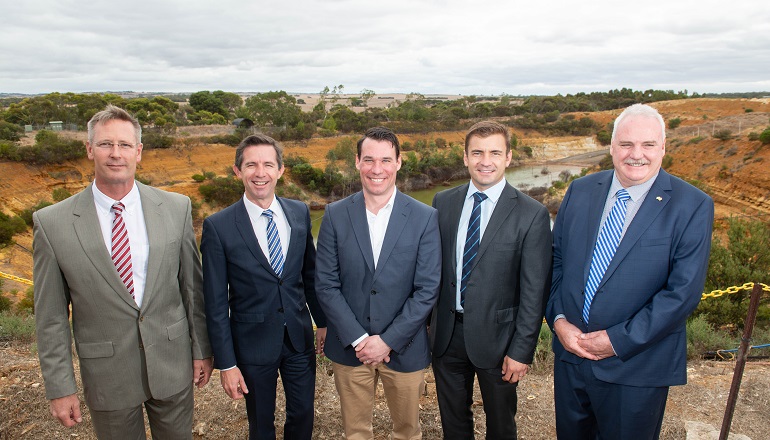
Compressed air energy storage (CAES) company Hydrostor has won A$9m in grant funding to develop a 5MW plant based on its technology, in Australia.
Canada-based Hydrostor is constructing a CAES facility at the disused Angas zinc mine outside of Adelaide, slated to come online in 2020.
Electricity stored in the plant will be dispatched into Australia’s National Electricity Market (NEM) to provide synchronous inertia, load shifting and frequency regulation, to support grid security and reliability.
Hydrostor’s facility will also enable the integration of variable renewable energy resources, such as solar and wind in the region’s grid.
By selecting the Angas zinc mine the project will repurpose existing underground mining infrastructure as the CAES system’s sub-surface air storage cavern.
Hydrostor’s CAES technology works by using electricity from the grid to run a compressor, producing heated compressed air.
Heat is extracted from the air stream and stored inside a proprietary thermal store preserving the energy for use later in the cycle.
Compressed air is then stored in a purpose-built underground cavern, which is kept at a constant pressure using hydrostatic head from a water column.
During charging, compressed air displaces water out of the cavern up a water column to a surface reservoir, and during discharge water flows back into the cavern forcing air to the surface under pressure where it is re-heated using the stored heat and then expanded through a turbine to generate electricity on demand.
The Australian Renewable Energy Agency (ARENA) provided A$6 million in funding, while the Government of South Australia awarded a $3 million grant in support of the project through its Renewable Technology Fund.
ARENA chief executive Darren Miller said: “Compressed air storage has the potential to provide similar benefits to pumped hydro energy storage, however it has the added benefits of being flexible with location and topography, such as utilising a cavern already created at a disused mine site.”