


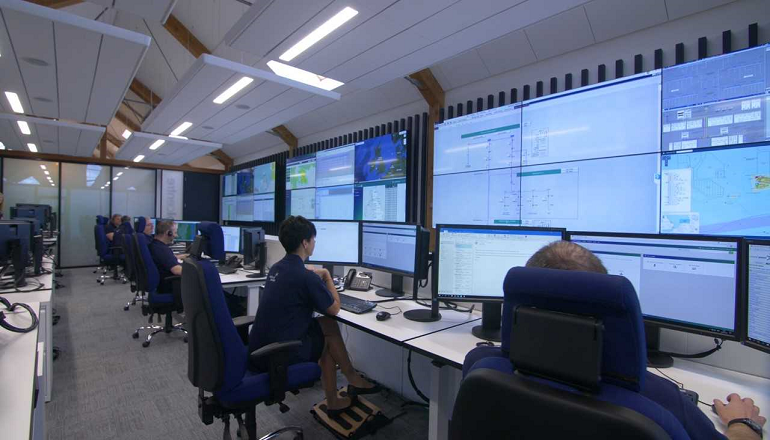
Scottish renewables services provider Natural Power has enhanced its remote asset management operations centre.
In 2018 Natural Power designed a new control services facility incorporating a decade of experience in its design.
The £540,000 state-of-the-art ControlCentre site is the largest, independently operated 24/7 control room in the UK, managing more than 175 renewable energy assets which are located throughout the UK, Ireland, France and the US.
Today the ControlCentre employs 22 staff and manages 5GW of renewable energy capacity comprising onshore and offshore wind, biomass, solar and hydro technologies.
The investment ensures the ControlCentre complies with all the new EU cybersecurity rules to protect clients’ assets and the grid, keeping them safe against potential cyber-attacks, as well as exploring new ways of increasing revenue for clients.
Site data arrives at the ControlCentre and is analysed by Natural Power’s software, using machine learning techniques, to ensure the turbines are operating at peak performance.
The ControlCentre is also capable of supporting the National Grid in balancing the network and ensuring just the right amount of power is being delivered into the network for homeowners and industry to use whilst enabling asset owners to sell when costs are optimal and to curtail when demand is low.
At present the system demand is in the region of 40GW, with wind accounting for approximately 8GW. Natural Power is controlling about 1.5GW which is equivalent to 3.75% of the entire UK demand from all fuel sources.
For capacity, Natural Power controls an estimated 20% of the entire of UK wind in transmission.
ControlCentre also helps to raise work orders and manage site access and egress remotely which manages safety risks on sites and therefore reduces the cost impacts that could come from a health and safety related incident.
The team can monitor data and react to alarms, bad weather or issues on site quickly which again saves money and reduces the reliance of onsite personnel at the asset.
For example, if a lightning strike causes damage to a turbine, the asset can be powered down remotely to minimise further damage and secure the site for the emergency services.
In terms of asset optimisation, the monitoring and analysis of turbine data can flag potential problems before they become critical and avoid the need, where possible, of very costly, major component exchanges such as gearboxes.
By taking a preventative approach to maintenance strategy, thousands of pounds can be saved annually and this far outweighs the relatively low cost of data analysis, regular inspections and a well-planned maintenance and servicing strategy.