


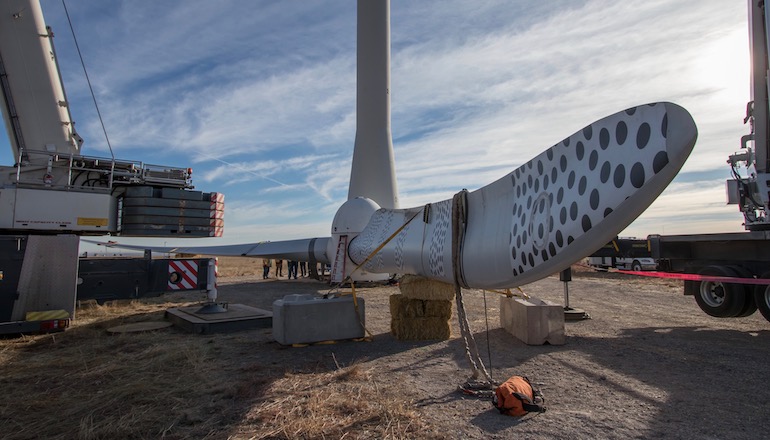
Three innovative 20-metre long wind turbine blades are undergoing testing in the US as part of a German government-backed project.
The blades, which were designed by the Fraunhofer IWES research centre and built by the German aerospace centre, have been installed at the US Department of Energy’s National Wind Technology Center in Boulder, Colorado, as part of the SmartBlade2 project.
The aim is to clarify how well the blades – designed with bend-twist coupling – are able to effectively dampen peak loads during strongly variable wind speeds.
Fraunhofer IWES said the results will serve as a basis for the further development of smart rotor blades.
It added that rotor blades equipped with bend-twist coupling are able to adapt to variating wind conditions by themselves.
“This reduces the overall load on the system, increasing the service life of the wind turbine as well as its power yield.”
Specially developed measurement systems have been integrated into the blade structure to assess the structural and aerodynamic behaviour.
“We are using several measurement systems that will allow us to monitor the entire length of the blades in order to capture the deformations, accelerations and loads they are subjected to,” said Fraunhofer IWES’ Christian Kress.
“In addition, the air flow around the rotor blades will be recorded at the surface using an aerodynamic measurement system,” he said.
The validation process will start with data analysis while the measurements are still being conducted, and will continue until the end of the project, during the autumn of 2019.
The SmartBlades2 project is funded by the German Federal Ministry for Economic Affairs and Energy and is being carried out by the Research Alliance Wind Energy, with its partners DLR, Fraunhofer IWES and ForWind, in collaboration with industry partners from GE, Henkel, Nordex, SSB Wind Systems, Suzlon, Senvion and Wobben Research and Development.