


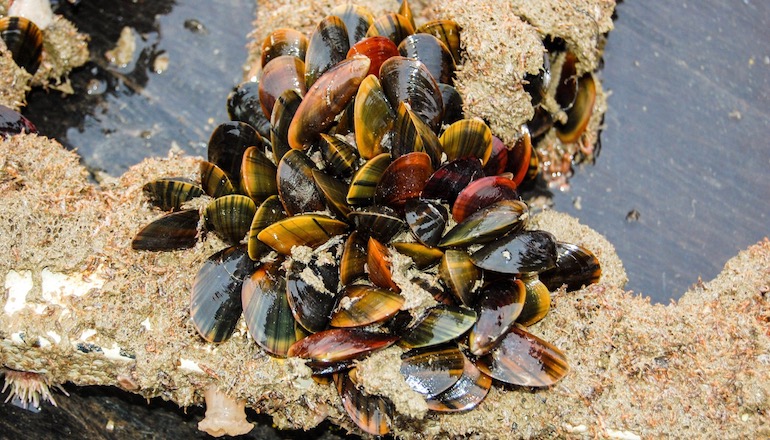
Diners have feasted and given the thumbs up to mussels grown for the first time at an unnamed offshore wind farm in the Belgian North Sea.
The shellfish have been cultivated as part of a test project set up by a Belgian consortium, including DEME Group, research institutions and other companies.
The project is investigating the potential of offshore wind turbine foundations to provide a habitat to grow mussels.
Secretary of State for the North Sea Philippe De Backer said: “Our national dish is mussels with fries. I’m very pleased to see that within some time, we will be able to serve true Belgian mussels. I believe that our North Sea has the ability to become a true sea farm in the long term, which will be a breeding base for not only mussels but also oysters and seaweeds.”
De Backer said he wants to put further focus on this. “That is why I have foreseen extra space within the Marine Spatial Plan to offer all opportunities to these innovative projects. We need to be a trendsetter in Europe in this matter as well.”
The ultimate aim is to market the mussels under Boni Selection, the Colruyt Group’s private label. Director of Colruyt Group Fine Food Stefan Goethaert said: “We believe there’s certainly a market for Belgian mussels. As soon as scaling-up is a reality, this product can be marketed, but considering we are now still in an innovation project with a proof-of-concept, this may take some time.”
It is claimed to be the first time mussels have been farmed in an “integrated” way with a combination of aquaculture production and wind energy and with different kinds of aquaculture products.
DEME Group said: “It is the very first time globally that mussels are being farmed using rafts on wind farms (with Parkwind and C-Power as businesses that help make this possible). Because shipping is regulated, this area forms a unique space for aquaculture.”
Biotechnologist at the Colruyt Group Wannes Voorend said the next generation of wind farms will be producing food in addition to energy.
But are the wind energy mussels tasty? The answer appears to be a resounding yes and possibly they are better for you too!
It is claimed the mussels have a higher meat content at 36% to 39% than other common mussels and the Colruyt Group’s taste-and-use tests found them to be “particularly flavoursome”.
Nancy Nevejan from UGent’s Laboratory for Aquaculture & ARC said there were added benefits: “In addition, what is noticeable is that these mussels grow particularly quickly. Over 12 months, they reached full size, while the Zeeland soil mussels need 18-20 months to reach maturity.”