The Carbon Trust has launched two new studies as part of a joint-industry initiative examining challenges in the development of floating offshore wind farms.
The studies will focus on high-voltage dynamic export cables and monitoring and inspection requirements for floating wind power projects.
BPP Cables will lead the study on export cables looking at how to fill a gap in the market for 130-250kV wires.
The Carbon Trust will launch a competition in the summer as part of the study to support cable manufacturers to develop suitable designs.
Oceaneering will deliver the second study investigating the monitoring and inspection requirements for floating wind farms.
Carbon Trust manager Rhodri James said: “The lack of available dynamic export cables is currently a key technical and commercial risk for floating wind projects and we are hopeful of playing an important role in stimulating the market to develop solutions for the industry.
“Monitoring and inspection also becomes increasingly important in large scale deployments and we again hope to play a role in both ensuring that current standards and guidelines are fit for purpose, while identifying novel technologies that can reduce operations and maintenance costs.”
The Floating Wind Joint Industry Partnership (JIP) is led by the Carbon Trust and backed by the Scottish government and 12 industry partners – EnBW, Engie, Eolfi, Eon, Iberdrola, Innogy, Kyuden Mirai, Orsted, Shell, Statoil, Vattenfall and WPD Offshore.
The JIP launched two projects last month focusing on heavy-lift offshore operations and the impact of larger turbines on floating wind structures.
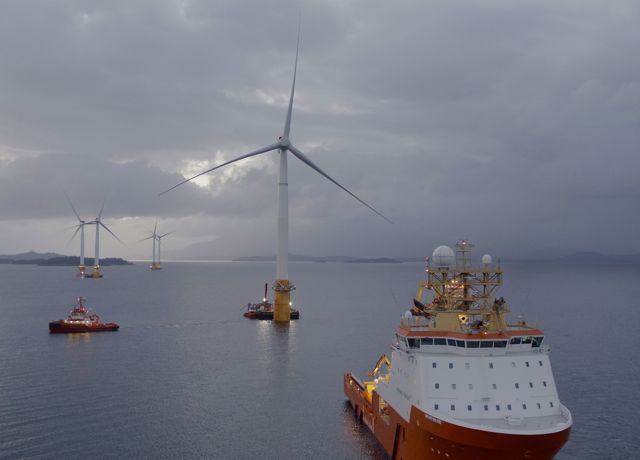
Image: Hywind Scotland floating offshore wind farm (Statoil)
Trust leads new floater probes
 By EBS