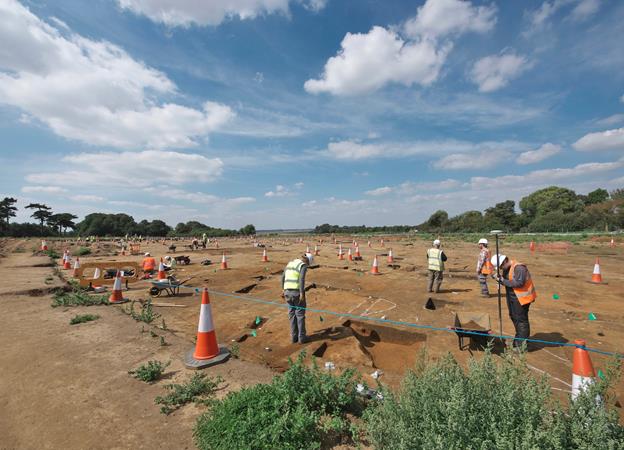
Archaeological works commissioned by ScottishPower Renewables (SPR) as part of the onshore work for its 714MW East Anglia 1 offshore wind farm has revealed a raft of information about Suffolk’s history as far back as Bronze Age times.
Wardell Armstrong is overseeing archaeological works across 60 hectares of Suffolk countryside, working with Suffolk County Council.
Up to 400 archaeologists have been involved in the work, which started in February, with a peak on-site workforce of around 250 at any given time.
The work has uncovered new insights from the Bronze Age, Iron Age, Roman period, Anglo-Saxons and into the medieval period.
Evidence of dwellings, places of work, pottery, tools and coins are among the things found.
SPR stakeholder manager Joanna Young said: “Hundreds of archaeologists and metal detectorists combing over fields in Suffolk is not the first thing you think of when you imagine an offshore windfarm – but it highlights the wide range of efforts needed to build a major energy project like ours.”
Wardell Armstrong post-excavation manager Richard Newman said: “It is not often that archaeologists get access to such a vast corridor of land, and the project has been fascinating.
“All of the finds will now be analysed further, and detailed reports will be produced, but it is safe to say we already know a lot more about Suffolk’s history today than we did a year ago.”
Underground cable laying work for EA1 will start in the next few months, and construction work is already underway at the onshore substation site in Bramford, SPR said.
Offshore work starts in 2018, with the turbines due to be installed in 2019, before the project is fully operational in 2020.
Image: SPR
EA1 reveals onshore treasures
Archaeological work for 714MW project uncovers heritage dating to Bronze Age
 By EBS