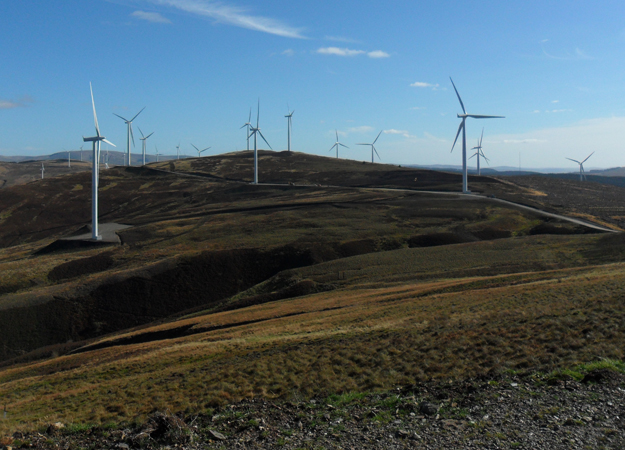
SSE has called for a change to Scotland’s planning regime to include a presumption in favour of development at existing onshore wind sites to allow extensions and repowerings.
The Perth developer said an increasingly challenging planning framework should include advice and spatial guidance to deliver additional megawatts at current sites and take advantage of the cheapest form of low carbon electricity available today.
SSE director of generation development Paul Cooley said: “Existing onshore wind sites will start to come to the end of their natural lives in the mid-2020s and 2030s.
“This presents an opportunity for repowering and extending existing sites to improve efficiency, make use of existing infrastructure and increase yield.”
The proposed measure is one of three asks to enable onshore to “start to stand on its own two feet without public subsidy”.
The company said new or repowered onshore wind would also require innovative routes to market, such as capacity market payments, ancillary services, co-location of storage, some form of market stabilisation instrument and bespoke offtake agreements.
The income from selling wind power should be underpinned by a strong carbon price, it added, and said maintaining the UK’s Carbon Price Floor into the 2020s would also be necessary.
“When stacked together with electricity income, make a compelling business case for future onshore wind development,” added Cooley.
SSE said the case for onshore wind would be driven further by striving for supply chain efficiency and best value in project development.
“We’re looking at where savings can be made to reduce development and construction costs and improve the efficiency of our sites.”
SSE has over 1200MW of onshore wind capacity in operation, 440MW in construction and a further pipeline of 900MW at various stages of development in the UK and Ireland.
Image: Clyde wind farm in Scotland (SSE)
SSE issues UK wind manifesto
Changes to planning regime needed to enable ‘subsidy-free' onshore
 By EBS