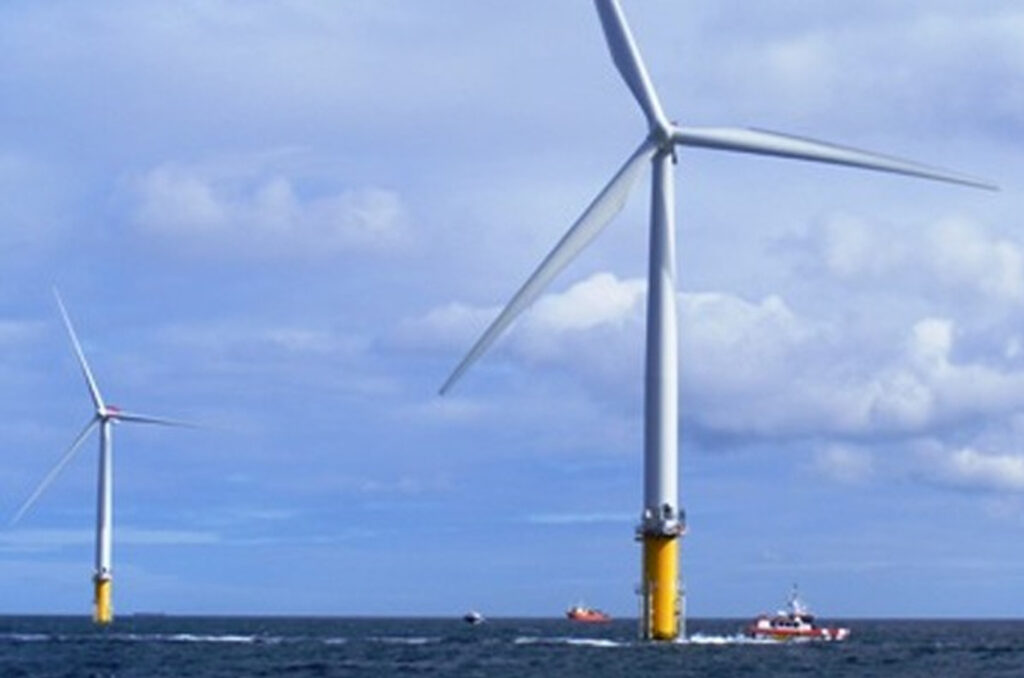
Portuguese company EDP has been awarded funding to develop new offshore wind power technology.
The Demogravi3 project aims to develop gravity based foundations for offshore wind turbines at an average depth of between 30 and 60 metres. It will be funded by the European Commission’s Horizon 2020 programme.
Demogravi3 will take four years to complete and test a wind turbine with an innovative gravitational foundation made of concrete and steel which will be installed on the Aguçadoura Offshore Wind Demonstration Farm, about 6km off the Portuguese coast.
It will use the underwater cable connecting the Windfloat turbine to a substation on land which will be decommissioned meanwhile to make way for Phase 2 of the project, to be installed in Viana do Castelo.
However, unlike Windfloat, Demogravi3 will be installed on the seabed, though it will have already been assembled and floated to the mooring location, avoiding the need for heavy lift vessels to anchor and assemble all the turbine components in an offshore environment.
“This initiative strengthens EDP’s commitment to an emerging area of wind production with strong growth potential,” said EDP chief executive António Mexia .
“By increasing competitiveness and their contribution to the fight against climate change, the installed capacity of renewable energy will tend to grow faster than in recent decades, and oceans will play a key role in this expansion.”
The project aims to utilise stronger wind power found at sea which leads to greater productivity. Its development will be coordinated by EDP, through EDPR.
In a statement EDP said that just 8GW of capacity is installed offshore in Europe compared to 120GW onshore.
EDP expects the share of wind power at sea in Europe to grow “rapidly”, reaching between 21 and 30GW by 2020.
The total budget for the project amounts to €26.8m, and non-reimbursable financing of €19.2m has been obtained from the European Commission’s Horizon 2020 Programme to support the Research & Innovation.
Image: reNews