


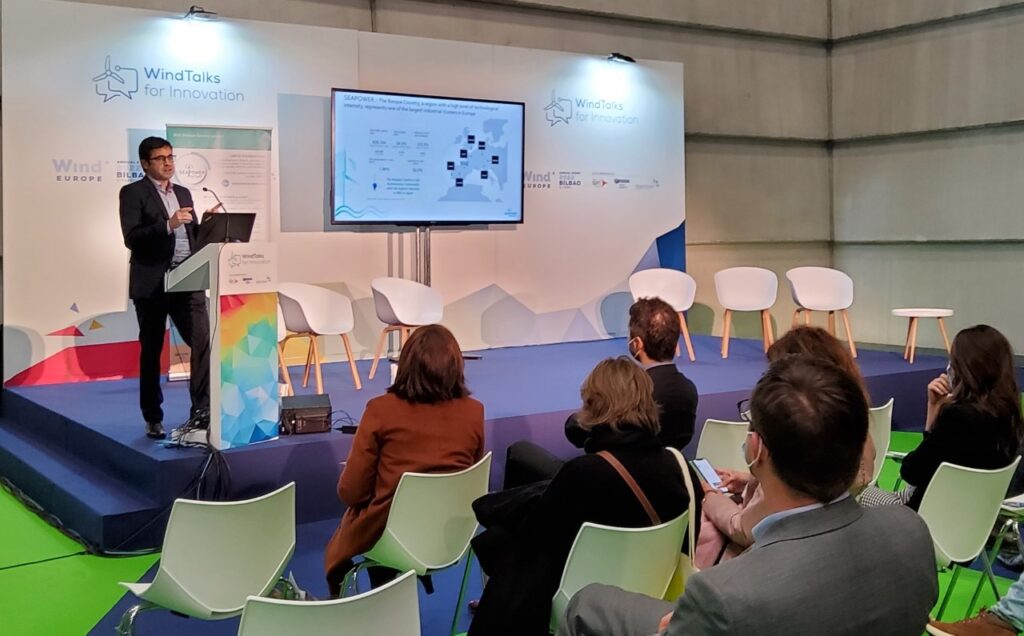
The Seapower project has presented its floating solution for large offshore wind turbines (>15MW) at WindEurope Bilbao.
After three years of work, the nine companies of the consortium have designed a new floating platform.
Also unveiled were a new foundation for offshore wind turbines, designs of large metal structures (towers and transition parts) with reduced cost and weight, and developments of different auxiliary systems.
Over the past three years, the Seapower consortium has developed solutions for floating platforms, fixed foundations, towers and auxiliary systems focused on the huge offshore wind turbines of the future.
This project, financed by the Basque Government and ERDF funds, has evolved with the market process, adapting the solutions originally proposed for wind turbines from >10MW to >15MW within three years’ time.
The Basque industry has acquired knowledge and offered added value through integral designs for the offshore wind sector, incorporating proprietary innovations, thanks to Seapower, the consortium said.
Sener has been the architect and coordinator of the project, and has developed the activities related to the floating solution.
The engineering and technology firm has successfully designed and tested in a wave tank a new semi-submersible floating platform for >15 MW offshore wind turbines.
Some key features of this innovative platform, under the trade name HiveWind, are its modularity, standardization, scalability, constructibility, small dimensions compatible with shipyards, reduced weight, high performance, and adaptability to the particular conditions of the site and manufacturing capacities.
Thanks to Seapower, a new company was created between Sener and Amper Group called Hive Wind Energy for the commercial operation of the platform.
IDOM, the other Basque benchmark engineering firm, has developed a new jacket foundation concept with the aim of reducing both CAPEX and OPEX costs.
The company has also conducted a tank test to validate its design.
At the forefront of the development of new designs for large metal structures, are two industry benchmarks, Haizea Wind and Navacel.
Haizea, manufacturer of towers for the wind industry, has reduced the tower section and joints by developing an innovative tower solution, saving 11% of the costs compared to its previous product.
Navacel, a manufacturer of large metal structures, has developed an innovative design of a low-weight, easy-to-manufacture transition part to connect the jacket foundation (IDOM) and the tower for >15MW wind turbines.
This transition part is designed to house the transformer and guard cells, in order to save space in the tower and simplify operation and maintenance activities.
Nautilus Floating Solutions has designed in the project an advanced numerical model for verification of the modes and natural frequencies of the tower (XXL) and the transition part within the main deck of the floating platform.
Ditrel has developed an innovative electrical connection concept at the base of the wind turbine, which is especially useful for floating platforms.
During the project, Ditrel has validated its 66 kV pre-connector and produced a small scale prototype for physical testing.
Erreka, manufacturer of bolted joints for offshore wind power, has adapted the design of the joint system between the new tower and the jacket developed for the project.
This bolt-on system has improved mechanical performance and is specially designed for the new flanges.
Jaso Tower Cranes, a specialist in lifting systems for the wind power sector, has designed a new elevator for the inside of the tower considering the floating offshore wind system.
This design prevents the linkage of the lift to the tower, making the joints via internal plates, so as not to interfere with the tower’s design.
Mugabe, an expert company in anti-corrosive surface coatings, has developed corrosion, biofouling, and impact-resistant coatings for the Seapower project, which were tested under real conditions and without presenting any deterioration.
Finally, the consortium has received support from two leading research centres in the wind energy sector: Tecnalia and Tekniker.