


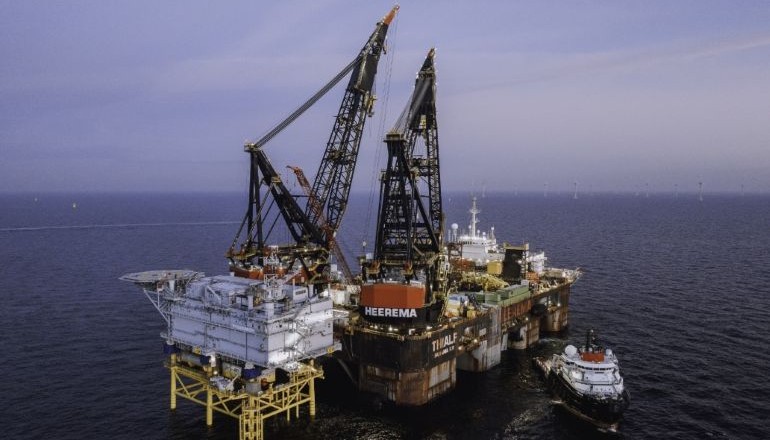
German transmission system operator 50Hertz is to focus its investments on grid connections of large offshore wind farms in the Baltic and North Seas over the next five years.
The company said its connected load for offshore wind farms in the Baltic and North Seas is to be increased to up to 7GW in 2030 from around 1GW today.
Between 2022 to 2026, 50Hertz itself intends to invest €5.6bn in overhead power lines, land and submarine cables and substations, which is almost twice as much as in the past five years – 2017 to 2021.
50Hertz is currently feeding the wind power from four Baltic Sea wind farms with an output of around 1GW into its onshore transmission grid.
By 2030, 50Hertz wants to connect further wind farms to the grid in the sea area between Rügen and the Danish island of Bornholm, off the Darss and for the first time in the North Sea.
50Hertz chief executive Stefan Kapferer said: “The laws now being introduced by the Federal Government to accelerate the expansion of renewable energy plants are important.
“Also to reduce dependence on imported energy sources in the medium and long term.
“However, politicians must not forget that energy from wind and photovoltaic systems must also be transported to the consumption centres.
“Legislative activities must therefore also include measures to accelerate the urgently needed network expansion.”
In addition to the expansion of renewable energies, the driver of this development is also the forecast of increasing demand for electricity in the company’s grid area.
This is due to the fact that more and more existing industries are decarbonizing their processes and new, energy-intensive companies will settle due to the high share of renewables in electricity consumption in the 50Hertz area.
The increasing electrification of the transport and heating sector will also lead to higher electricity consumption, 50Hertz said.
Current studies by 50Hertz predict an increase in electricity demand in the grid area of 30 to 40% by 2030.
As early as 2021, electricity consumption in the eastern German states, in Berlin and Hamburg has risen by 3% to 103 terawatt-hours (TWh) compared to the previous year.
New overhead lines and underground cables are also required on land for the transport of renewable electricity.
The Network Development Plan 2035 (2021) confirmed by the Federal Network Agency provides for around 500km of additional grid reinforcement and expansion measures in eastern Germany and Hamburg by 2035.
This includes another extra-high-voltage direct current (HVDC) connection between Mecklenburg-Western Pomerania and the North Frisian coast.
In the Heide area, 50Hertz and the transmission system operator TenneT want to build a hub for direct current that can absorb and distribute wind power from the sea as well as from land.
Among other things, this electricity is to flow to the consumption centers via the SuedOstLink, which is already in the planning approval process, and the SuedOstLink Plus , which is still to be approved.
In order to be able to implement these grid expansion projects more quickly, tighter approval processes, better equipped authorities and the focused recruitment of skilled workers are required, among other things, the company said.