


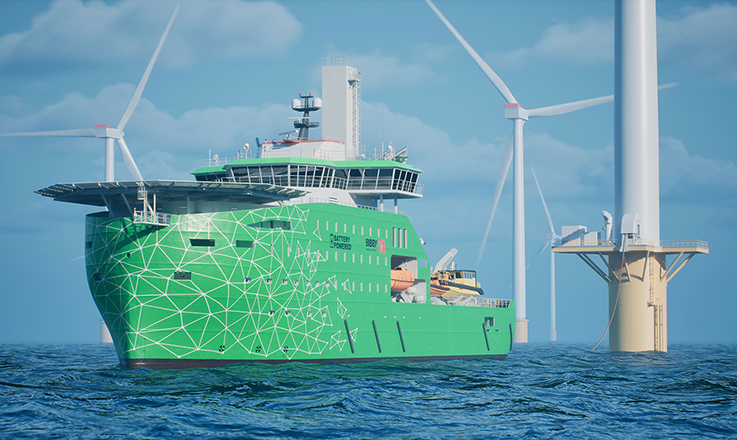
Bibby Marine, Kongsberg Maritime and Stillstrom have written an open letter calling for urgent action to reduce the offshore wind sector’s carbon footprint.
It comes as Bibby Marine is investing in the world’s first zero-emission commissioning service operation vessel (eCSOV) as part of its commitment to decarbonising its operations.
In the open letter, the three companies wrote: “We are calling on our colleagues across the industry to respond to pressures on the cost of wind farm construction with a commitment to the adoption and deployment of technologies that will wipe out our carbon footprint.
“These technologies exist today and offer commercial advantages over conventionally fuelled vessels – let’s celebrate them, nurture them, and act to deploy them; together.
“Our sector has an opportunity to deliver more projects without producing more emissions. Using available technology, we can collaborate to reduce costs while at the same time reducing our impact on the climate. As the cost of projects rise, we need to work together to prove this can be done, at scale, anywhere.”
While the carbon footprint of offshore wind power generation is 10 times lower than fossil-generated energy on a per MWh basis, the letter warns that the rapid global expansion of renewables will lead to more carbon emissions.
“If we truly want to be a net zero emissions sector, we need to work harder to eliminate our sources of carbon emissions,” the companies added.
The letter highlights that vessel emissions during construction, installation and operations represents a “significant problem” for the sector.
It adds: “Working with our partners – developers, owners, EPCIs, and O&M providers – we are laying the keel of a vessel and establishing the network of infrastructure that will take us to net-zero infield emissions.
“Infield charging can be delivered today to extend the capacity of eCSOVs and eSOVs supporting operations. This lowers operating costs, improves the working environment, and reduces emissions by as much as a fifth.
“But to encourage investment in the necessary infrastructure, OEMs need demand signals. Across our industry’s sub-sectors, we have come together to provide that demand signal and create the momentum for lower construction and development costs that will unlock the offshore wind pipeline and continue to drive the energy transition.”