


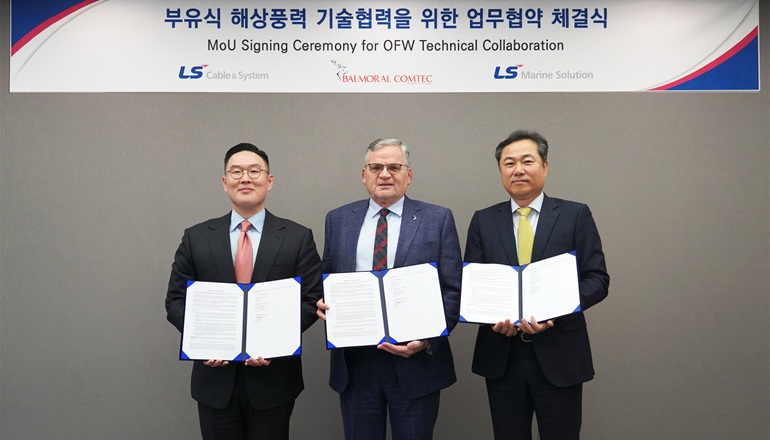
Balmoral has signed a memorandum of understanding (MoU) with South Korean players LS Cable & System and LS Marine Solution to cooperate in floating offshore wind.
This agreement follows LS Cable & System’s recent MoU with Norway’s Equinor in relation to the 750MW Bandibuli/Firefly floating offshore wind project in South Korea.
LS Cable & System has developed dynamic cables designed to operate stably in harsh offshore environments, a first in Korea.
Through this MoU, the South Korea-based companies aim to collaborate with Balmoral Comtec to establish a secure and optimised operational system for floating offshore wind cables.
Additionally, LS Marine Solution will enhance installation efficiency and ensure stable maintenance, supporting the successful execution of the project.
South Korea’s Ministry of Trade, Industry, and Energy (MOTIE) has included floating offshore wind power for the first time in its 2024 Fixed Price Contract Competitive Bidding for Wind and Solar Power Facilities.
As a result, Equinor’s Bandibuli project was selected, and LS Cable & System has partnered with Equinor to gain an early market advantage.
An LS C&S official said: “Although floating offshore wind currently accounts for only about 1% of the market, it is expected to grow rapidly.
“Through the Bandibuli Project, we aim to secure core technologies and continue leading the market through ongoing technological advancements and global cooperation.”
Bill Main (pictured centre), Managing Director of Balmoral Comtec, said: “This Memorandum of Understanding (MoU) highlights our ongoing commitment to the floating wind sector. We are delighted to collaborate with LS Cable & Systems and LS Marine Solution on the Bandibuli project.
“Balmoral Comtec is uniquely positioned to support the offshore wind industry, drawing on our decades of experience. By leveraging our innovative products and expertise, we aim to help accelerate the industry’s growth and meet its ambitious targets.
Floating offshore wind power generates electricity using floating structures at sea, allowing installations in deeper waters compared to fixed-bottom wind farms.
According to the Global Wind Energy Council (GWEC), the floating offshore wind market is expected to grow from 35GW in 2020 to 270GW by 2030.