


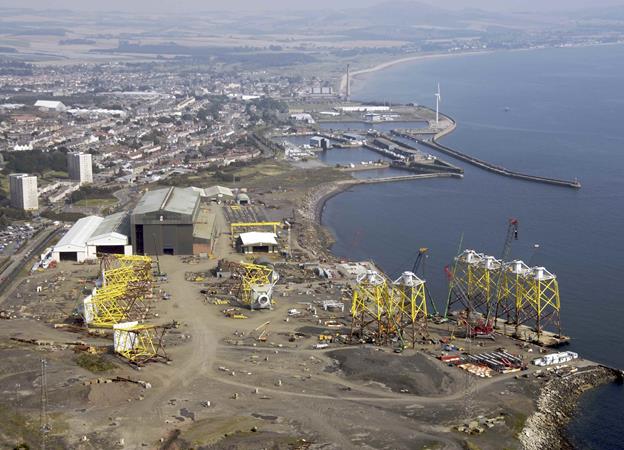
Scottish fabricator BiFab believes a contract for eight jacket foundations for the 450MW Neart na Gaoithe offshore wind farm will be lost, following a decision by the UK and Scottish governments not to provide further financial support to the company.
A BiFab working group set up jointly by both governments at the start of November concluded that “there is currently no legal route to provide further financial support to BiFab in its current form”.
BiFab said the company and its management were given no access or opportunity to address the working group to explore options and that it appears the foundations contract would be lost along with “the 400-500 jobs it promised to create”.
The company said it had proposed several project execution alternatives to keep the work at Scottish yards despite “reasonable assurance options” being unavailable following a Scottish government move last month which ruled out providing financial guarantees for the work.
“This included an option to work alongside Saipem in the Fife yards with the full support of our union partners,” the company said in a statement.
The statement added: “BiFab management invited Scottish Ministers to jointly present this option to Saipem and NnG developer EDF. Unfortunately this did not happen. This option still exists today.
“As a result of recent correspondence from Scottish Ministers, it is apparent that creditor support from the Scottish Ministers required to pursue critical solutions for BiFab will be unavailable.
“While incredibly disappointed, BiFab management continues to consider all options available to the business.”
The UK and Scottish governments said another joint working group would be formed to consider ways to strengthen the renewables supply chain and secure future opportunities.
Scottish Economy Secretary Fiona Hyslop said it had “left no stone unturned in our search for a solution to the challenges faced by the business”.
She said: “As a minority shareholder, we have been exhaustive in our consideration of the options available to us to financially support BiFab from public funds.
“The Scottish government has been clear that State Aid regulations are a barrier to us providing guarantees on the contract from Saipem to build foundation jackets for the Neart na Gaoithe project.
“The UK government has similarly concluded that there is no legal route for them to provide support.”
She added that the situation at BiFab was a “culmination of a number of issues, the main one being the unwillingness of the parent company and majority shareholder JV Driver to provide working capital, investment or guarantees for the company”.
But BiFab said Scottish Ministers’ continued focus “on JV Driver’s alleged lack of investment, guarantees and capital as the primary cause for its current situation… cannot be further from the truth.”
Its statement added: “Recognizing the growing state aid challenges faced by Scottish Ministers early in 2020, JV Driver offered, on numerous occasions, to transfer some or all of its shares in BiFab to Scottish Ministers at no charge to the Scottish purse.
“This offer was made to facilitate an ownership position by Scottish Ministers that could support further investment if and when required. This offer was never pursued by Scottish Ministers. This offer still stands today.”
The Scottish Secretaries of the GMB and Unite unions, Gary Smith and Pat Rafferty, said there could be no confidence in the process “until the minister shares the legal advice which promoted the decision to walk away from BiFab”.
They added that the “choreography” of the joint statement, excluding unions and the employer and “slipping the bad news under the announcement of the COVID Christmas guidelines” was an “act of bad faith”.
The Scottish government “can no longer cry grievance at Westminster over the failure in offshore wind when they are now acting in unison”, Smith and Rafferty added.
“The signal this sends out to the renewables industry is very clear, it’s business as usual. The jobs of the future will continue to be exported to the rest of world and subsidised by the bill payer to the tune of billions.
“At best Britain will get scraps off the table from its own offshore wind market but it looks like both governments have buried any credible hopes for a meaningful green jobs recovery in Scotland.”