


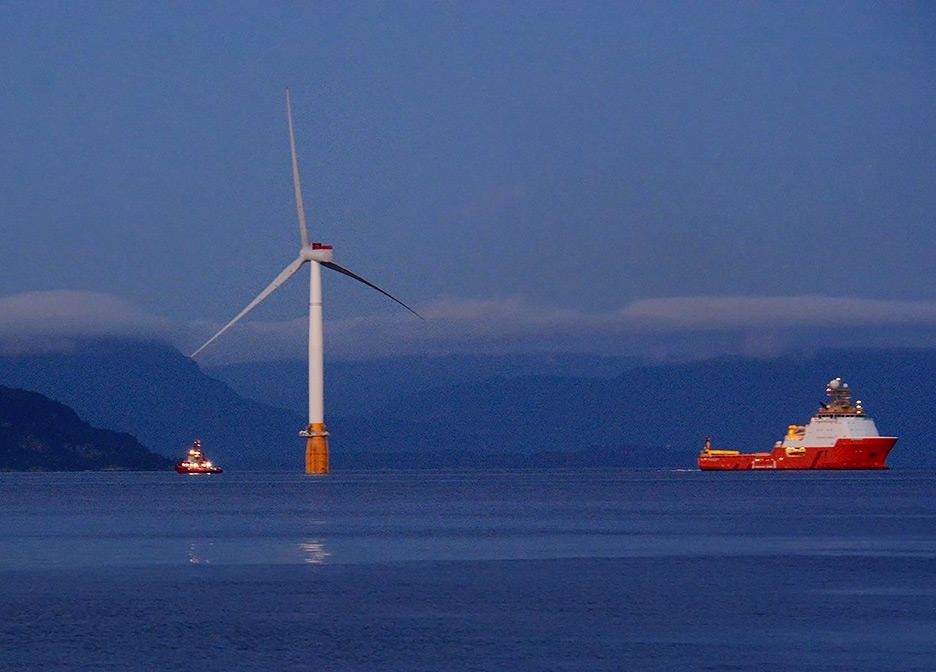
The Carbon Trust’s Floating Wind Joint Industry Project (JIP) has launched a competition today aimed at accelerating the development and commercialisation of floating wind.
The Floating Wind Technology Acceleration Competition has a budget of £1m from the Scottish government and is seeking innovations that drive forward floating wind technology.
It aims to attract ideas both from within the offshore wind industry and across a wide variety of other sectors including marine, automotive, oil and gas, aerospace, robotics and manufacturing.
Technologies that address four key challenge areas are particularly being sought.
One area is for technologies that enable effective and safe major component exchange offshore, while another is the development of cost effective and safe disconnection and re-connection operations when turbine foundations are towed to port.
A third covers new methods for cost effective, safe and reliable monitoring and inspection of large numbers of mooring lines, power cables and foundation structures.
The fourth area focuses on new methods, materials or technologies that reduce the cost of mooring systems through easier and safe installation and/or reduced maintenance requirements.
Innovators will also be able to make applications in a miscellaneous category to enable additional novel ideas to be considered.
Scottish energy minister Paul Wheelhouse said: “I am delighted to announce the £1m Floating Wind Technology Acceleration Competition that Scottish Government are partnering with the Carbon Trust to deliver.
“Given that 80% of offshore resource across the world is in deeper water, floating offshore wind will undoubtedly play a key role in renewable generation in the future.
“Finding solutions to the key challenges identified as part of the competition will facilitate faster deployment of commercial level floating offshore wind farms, allowing this technology to reach its potential.”
Carbon Trust director of offshore wind Jan Matthiesen said: “Offshore wind in Europe has delivered cost reduction at a scale that no one anticipated, cementing its role as a truly competitive energy generation technology.
“It is now cheaper than building new conventional power plants. Floating wind is a proven technology and promises to be the next renewable power success story, but to meet the scale of ambition we need to accelerate cost reduction.
“By 2030, the Carbon Trust estimates that a further 12GW of floating wind capacity could be built globally, requiring around £32.4bn of capital investment.
“This rapid growth provides opportunities to participate in this exciting new sector and we welcome ideas from across industry to support this important sector.”
The Floating Wind JIP is a collaborative effort between the Carbon Trust, Scottish Government and 14 offshore wind developers: Orsted, Equinor, Engie, Eolfi, Eon, Innogy, Shell, Iberdrola, Kyuden Mirai Energy, EnBW, WPD, SSE, TEPCO and Vattenfall.