


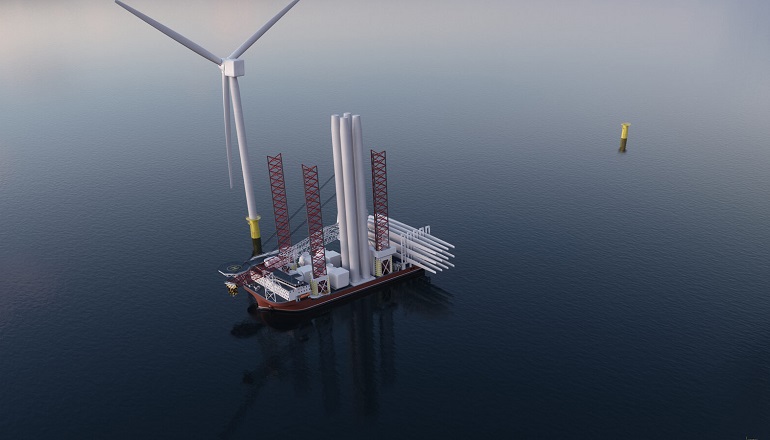
Danish vessel and shipping consultancy Knud E Hansen has finalised a new offshore wind transport and installation vessel design.
The design enables the transportation of six of the new-generation 14-16MW wind turbines, and at least five of the next generation 20MW-plus turbines, the company said.
The Atlas C-Class vessel has a jacking deadweight of 18,000 tonnes, 6800 square metres of cargo deck area and a 3000 tonne 37 metre-high crane.
The jacking deadweight and crane capacity also enable the vessel to carry at least four of the extra-large monopile/transition piece foundations, which are required for turbines in the 14-16MW range.
Cranes, thrusters, generators and jacking systems can all be modified and selected based on manufacturer availability such that the vessel can be tailored to suit the individual needs of each client, said Knud E Hansen.
Negotiations are ongoing with companies in the offshore wind sector to further develop the Atlas C-Class platform based on their individual requirements, said the company.
The Atlas C-Class is the first in a series of planned WTIV platforms of varying sizes and one already under development is a smaller A-Class platform that can carry four 14MW turbines and is equipped with a 1,600 tonne crane for clients installing wind turbines on pre-installed foundations, Knud E Hansen said.
In the design, the vessel is powered by eight identical generators, each with 3340kW of electrical power, which are arranged in two independent engine rooms.
A DC grid system allows the engines to run at variable speed for maximum fuel efficiency.
The DC grid system is coupled to a 4MW battery pack for load levelling and peak shaving.
The batteries can supply “instant power”, which reduces the need for “spinning reserve power” from generators running on standby and during DP operations and they make it possible to recover approximately 60% of the energy that is used to jack the vessel to the operational height.
To further minimize power consumption, the vessel design includes four azimuth stern thrusters.
The spud cans are optimised for the “lowest possible” seabed penetration and are fitted with buoyancy boxes to reduce the draught in port, reduce the load on the seabed when the vessel is jacked up, and to help retract the legs out of muddy sea beds.
The three decks above include a total of 130 cabins for contractors, crew and officers.
The top deck consists of a bridge with centerline and wing consoles and a large helicopter deck. Below the main deck is a gym, cinema, TV room, games room, and sauna as well as a laundry room and store rooms.