


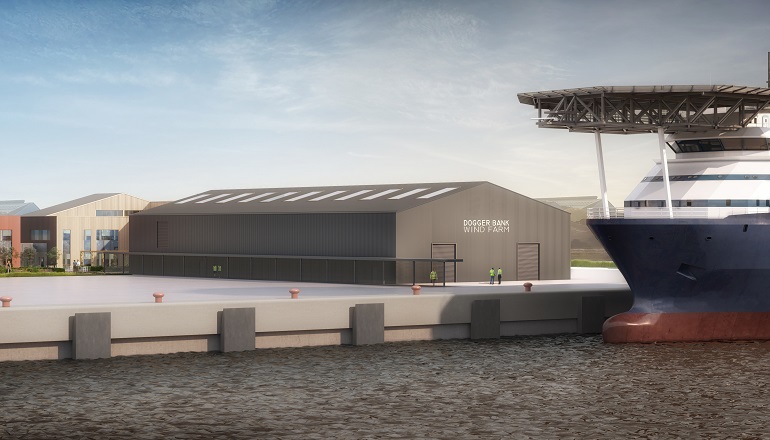
Dogger Bank Wind Farm’s new operations and maintenance (O&M) base will be constructed and operated to meet net zero requirements.
The Port of Tyne facility will be in line with the UK Green Building Council’s (UKGBC) Net Zero Carbon Buildings Framework, to ensure transparent and robust reporting of its sustainability credentials.
The O&M base will support what will become the biggest offshore wind farm in the world upon completion.
Construction of the base is expected to start shortly and will end in the third quarter of 2022, ahead of wind farm operations starting in 2023.
The O&M base has been designed by international design practice Ryder Architecture, headquartered in Newcastle.
Equinor is managing the construction project and has contracted global real estate advisor CBRE as the local project manager, and Bowmer + Kirkland (B+K) as the principal contractor for the facility.
B+K will manage the work from their offices in Sunderland, close to the Port of Tyne where the base will be located.
Halfdan Brustad, vice president for Dogger Bank at Equinor, said: “This modern and attractive facility will support over 200 people working directly on Dogger Bank, and be a proud base at the heart of the North East for teams working on the world’s largest offshore wind farm.”
The 3407 square metre base will use low carbon materials and will meet the highest energy efficiency classifications.
Solar PV panels will be installed for onsite renewable generation, and EV charging points will be available so staff and visitors can travel there in low emissions vehicles, further reducing the wider impact.
In the UK, the industry recognised framework for verifying the Net Zero Carbon (NZC) performance of the
CBRE will work closely with the project team to apply industry recognised approaches to material selection, operational energy modelling and carbon accounting, submitting a final evidence pack for third party review.
To demonstrate commitment to NZC and to drive down the cradle to practical completion embodied carbon, the project has set an internal carbon price (ICP) for the facility aligned with industry best practice.
Consideration of this ICP rate alongside the market cost of associated materials has allowed the design team to make a financial case for selecting materials with best in class environmental performance.