


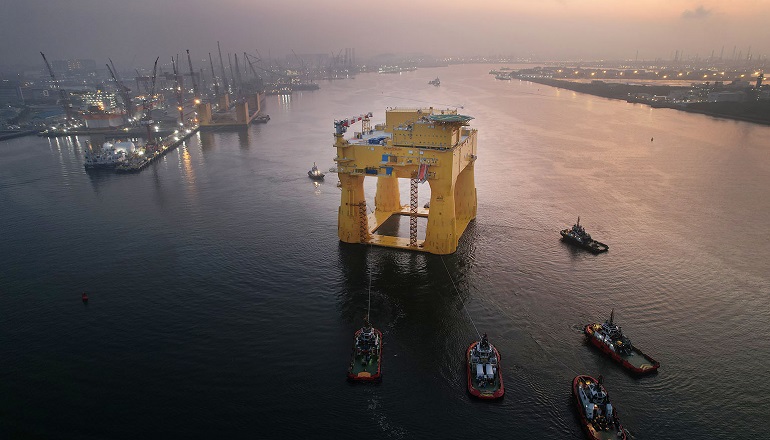
The platform for the 900MW DolWin5 offshore converter has left Seatrium’s shipyard in Singapore and is expected to arrive at the Aibel shipyard, in Haugesund in Norway next.
After three years of construction, the heavy-duty transport vessel Mighty Servant 1 has “piggybacked” the platform and set off on its journey.
Mighty Servant 1 will sail around 13,000 nautical miles at sea around the Cape of Good Hope for around 60 days and is expected to arrive at the Aibel shipyard in December.
There, Aibel, as a partner in the Aibel-Seatrium consortium (formed from the merger of Sembcorp Marine and Keppel Offshore & Marine), will install the final technical equipment.
In addition, Hitachi Energy, as Aibel’s subcontractor and supplier of HVDC technology, will install the converter and transformers.
Next summer, the platform will be transported self-floating and installed at its final destination in the German North Sea.
With the DolWin5 grid connection, for the first time, a 66kV direct connection is being used.
Compared to previous projects, a wind farm substation is no longer required. Instead, the wind power generated off the coast of Lower Saxony, Germany, will be transmitted directly as three-phase current to TenneT’s DolWin Epsilon converter platform.
The elimination of the wind farm’s substation not only minimizes costs, but also construction time and interference with the marine ecosystem.
Tim Meyerjürgens, COO of TenneT, said: “Following the recent commissioning of DolWin6, this project is also on the home stretch – this is of enormous importance as the grid expansion in the North Sea needs to be accelerated in order to achieve our expansion targets in Germany.
“With DolWin5 and the elimination of the substation, we can show that we are striving for and implementing more efficient solutions.
“This is just an intermediate step before we set new standards with the 2GW programme.”
A special feature of the 82-metre-long, 73-metre-wide and 84-metre-high platform is the gravity-based foundation. So far, this has only been used with DolWin beta.
It is based on the concept of a self-installing, gravity-based construction.
The platform is slowly lowered to the 31-metre-deep seabed by weighting the platform’s four steel legs with water.
The water is then replaced with heavy gravel to keep the platform permanently in place for 30 years. Since there is no need to drive piles into the seabed for anchoring, so the installation is quieter, minimising impact on marine life.
When the platform reaches the end of its service life, the ballast can be removed from the hull and the complete platform can be towed to a port for dismantling.