


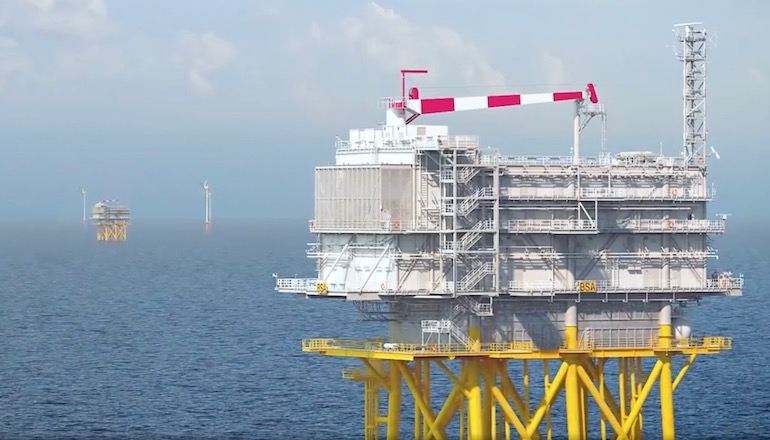
Wind farms in the German and Dutch North Sea provided over 30TWh of power, according to figures from Dutch grid operator TenneT.
According to the group, 19.24TWh of wind energy from the region was transmitted to the German grid in 2023, and a further 11.54TWh entered the Netherlands.
For the Dutch figure, this represents an increase compared to 2022’s 7.91TWh, primarily due to the commissioning of the new Hollandse Kust (noord) offshore grid connection system by TenneT and the corresponding expansion of offshore wind farms in 2023.
TenneT’s transmission capacity in the Dutch North Sea increased to 4666MW, while onshore wind energy capacity in the Netherlands in 2023 was 6854MW, which generated 7.96TWh of wind energy (up on 2022’s 5.14TWh).
In Germany, the annual result for 2023 was around 9% below the previous year’s figure of 21.13TWh.
Due to the simultaneous strong increase in onshore wind power generation, the total result in Germany in 2023 was 148.97TWh (2022: 122.79TWh).
At around 13%, the share of North Sea electricity in 2023 was around four percentage points lower than in the previous year (17.2%).
Since the completion of the 13th offshore grid connection (DolWin6) in September 2023, TenneT’s offshore transmission capacity in the German North Sea has increased to 8032MW (previous year: 7132MW).
TenneT COO Tim Meyerjurgens said: “We can see that the expansion of our offshore grid connection systems in the Netherlands and Germany is progressing well. And onshore grid expansion in Germany is also finally making progress thanks to numerous acceleration measures over the past two years.
“Nevertheless, the many lost years are now having an increasing impact on the ‘wind yield’ in the German North Sea. Due to the still numerous congestions in the onshore electricity grid, the large wind farms in the North Sea have to be shut down more and more frequently because there are hardly any large conventional power plants in the north that could be throttled instead.
“As a result, the associated redispatch slows down the generation of offshore wind power. This not only affects the amount of electricity fed into the grid, but also impacts its price development. This shows that Germany must continue to accelerate the expansion of the grid and the major electricity highways so that the potential of the North Sea as a wind power plant for Germany and Europe can be utilised efficiently as soon as possible.”