


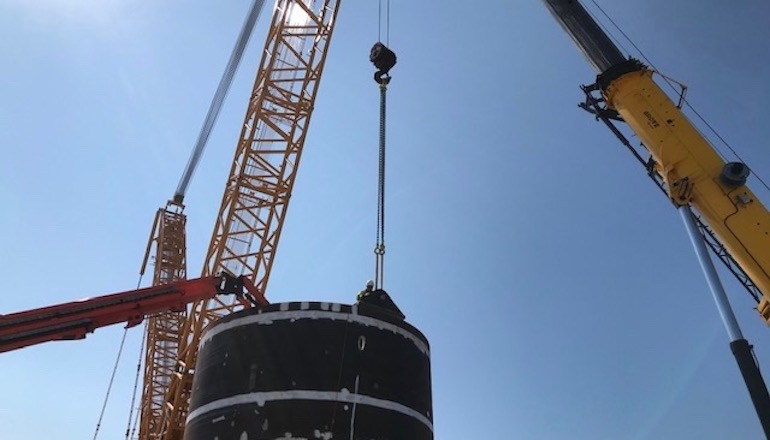
Sif, Van Oord and other offshore wind players are partnering in a research project in the Netherlands to further commercialisation of new techniques for the installing the biggest monopiles in the offshore wind market.
Sif will be providing monopiles for the Sustainable Installation of XXL Monopiles (SIMOX) research project, which is running for three years.
SIMOX will aim to gather more data on driveability, environmental and ecological impacts of pile driving techniques for XXL monopiles, with a focus on underwater noise during pile driving, as well as bearing capacity of the soil.
The implications for decommissioning at the end of the monopile service life will also be assessed.
The SIMOX project is part of the GROW programme in the Netherlands and is led by a team at the Delft University of Technology.
Deltares and TNO will also take active part in research and test campaign.
Offshore contractors Van Oord, Boskalis and Seaway7 will be involved in on- and nearshore tests, supported by the Delft Offshore Turbine (DOT).
IHC IQIP, CAPE Holland and GBM Works will work with Sif to provide the monopiles and installation technologies.
Operational aspects will be monitored and assessed by Shell, RWE and Siemens Gamesa Renewable Energy.
SIMOX will also involve environmental and regional economic stakeholders in an early stage.
The project will involve testing multiple techniques to develop new and necessary technical and environmental knowledge.
The Netherlands Enterprise Agency (RVO) is supporting the participating companies with €2m in funding and the Dutch government is contributing €4m.
Installation methods for monopiles face major barriers for future large monopiles, Sif said.
The dominant method used now to drive monopiles into the seabed is the hydraulic impact piling (hammering). The major disadvantage of impact piling methods is the generation of underwater noise, which is harmful to cetaceans and other marine animals.
Impact piling cannot be used to extract monopiles when offshore wind farms reach the decommissioning stage.
Alternative installation technologies are being researched, developed, and tested at various Technology Readiness Levels (TRLs) but, as yet, none of these has reached a TRL that makes it a preferred/ready solution for the installation of future XXL monopiles.
XXL monopiles are classed as structures with a diameter between 7.5 metres and 11 metres that weigh 1000-2400 tonnes.
The project will study and test various alternative technologies and aims to bring the required knowledge for these options to the same level.
The techniques that are included in SIMOX are conventional vibratory driving enhanced by means of introducing fluidisation of the internal soil column and gentle driving of piles, which is an emerging technology that combines a vertical vibratory excitation with a high-frequency torsional shaking.
Blue piling, a modification to the conventional impact driving which reduces noise, will be included in the modelling of driveability and noise prediction, based on data generated outside of SIMOX.
GROW director David de Jager said: “SIMOX is unique in its comprehensive approach to understand and assess multiple technologies under similar, controlled conditions.
“Tests with scaled monopiles will be performed in laboratories, at two onshore sites and at a nearshore site.
“This is also a good example of how the GROW consortium wants to (co)operate: a joint effort to tackle a challenge that is relevant for the offshore wind industry as a whole.”