


An EUHorizon 2020-funded project has successfully completed the validation of an innovative dynamic cable concept for deepwater floating wind projects.
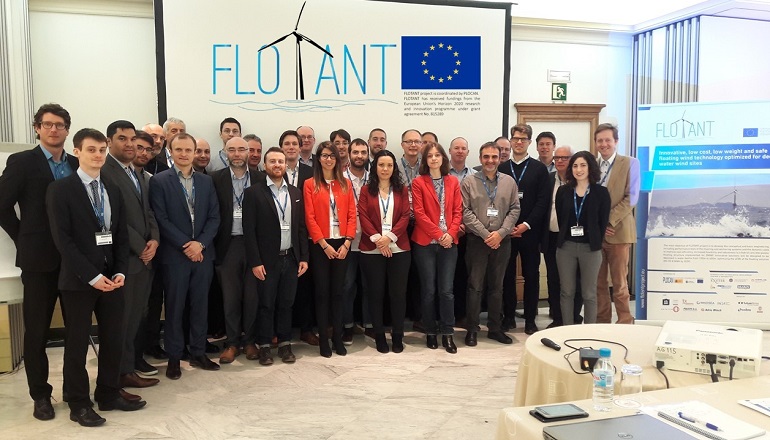
The FLOTANT project consortium aims to develop conceptual and basic engineering for a hybrid concrete-plastic floating wind farm, looking at innovative solutions for anchoring and mooring systems, and dynamic cabling, including performance testing.
Its objective is to improve cost-efficiency and increase robustness and flexibility in floating wind subsea design for deeper waters from 100 to 600 metres.
Consortium partners Innosea, part of AqualisBraemar LOC Group, Hellenic Cables, ITA and the UK’s University of Exeter have successfully completed the dynamic cable scope of work.
As part of the dynamic cable scope, Hellenic Cables with ITA completed the design and engineering of an innovative braided armour for the protection of the dynamic cables cross-section.
This consisted of the application of an outer jacket made of carbon fibre reinforced composite, in addition to the development of a solution for sensor integration and interconnection of fiberoptic sensors for structural condition monitoring.
“FLOTANT seeks to open the possibility to develop floating wind in even deeper waters than is possible today, unlocking potential for far greater wind power resources at lower cost.
“The innovative braided armour cross-section design of the dynamic cabling in such extreme water depths is pivotal to the project’s success,” said Mattias Lynch, engineering director at Innosea.
The project is coordinated by Ayoze Castro, head of Innovation unit of Oceanic Platform of the Canary Islands (PLOCAN).
It includes 17 partners from eight countries, including Innosea, which was appointed to the consortium to provide a range of services across six of the consortium’s work packages – including for the dynamic cable and export system optimisation.
Innosea was also responsible for the configuration analysis of the dynamic cable, while testing and validation of mooring and dynamic cables was conducted at the Dynamic Marine Component (DMaC) at the University of Exeter.
The next phase of the project for Innosea will be to finalise the floater global performance analyses to confirm its suitability versus project defined sites.