


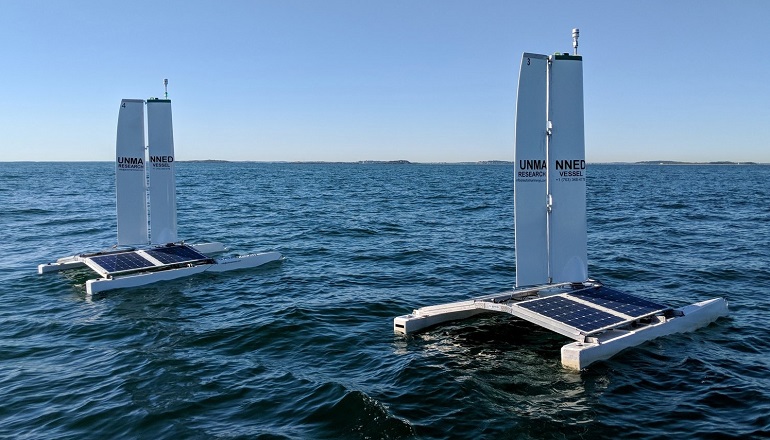
Offshore wind developer Equinor and US start-up Autonomous Marine Systems (AMS) have launched an autonomous sailing platform to cut the cost of gathering data needed for developing offshore wind projects.
The wind- and solar-powered Datamaran vessel, developed by AMS, carries a LiDAR device to collect data on wind and weather conditions at remote offshore wind lease areas.
Over the last 18 months, Equinor and Massachusetts-based AMS have conducted studies and built prototypes to test the system.
According to the partners these studies have shown “dramatic improvements in lead time, cost and areal coverage versus today’s options”.
Currently, offshore data is collected by a combination of a large vessel traversing the offshore wind area and a LiDAR system mounted to an anchored, stationary buoy.
Equinor Wind US president Christer Af Geijerstam said: “Equinor’s collaboration with Massachusetts start-up AMS underscores our commitment to collaborate with, invest in, and support local business.
“The emergence of the US offshore wind energy industry presents an exciting opportunity for local, nimble, innovative companies to partner with established wind-farm developers.”
The Datamaran operates autonomously without a manned support vessel, continuously transmitting acquired data and vessel health status to onshore operations via fault-tolerant communication channels.
The vessel is propelled by a rigid wing sail while the LiDAR, navigation, and communication systems are powered by deck and sail mounted solar panels and large batteries.
Standard integration interfaces enable broad flexibility in sensor payload and survey types such as standard meteorological ocean, bathymetric and hydrographic, current and wave characteristics, avian and marine mammal detection, and alerting.
AMS chief executive Ravijit Paintal said: “In keeping with our partnership with Equinor, we’ve named this latest class of vessels ‘Njord.’
“We launched it successfully last week, and now we’re looking forward to deploying the technology worldwide to deliver order-of-magnitude benefits to offshore wind development.”