


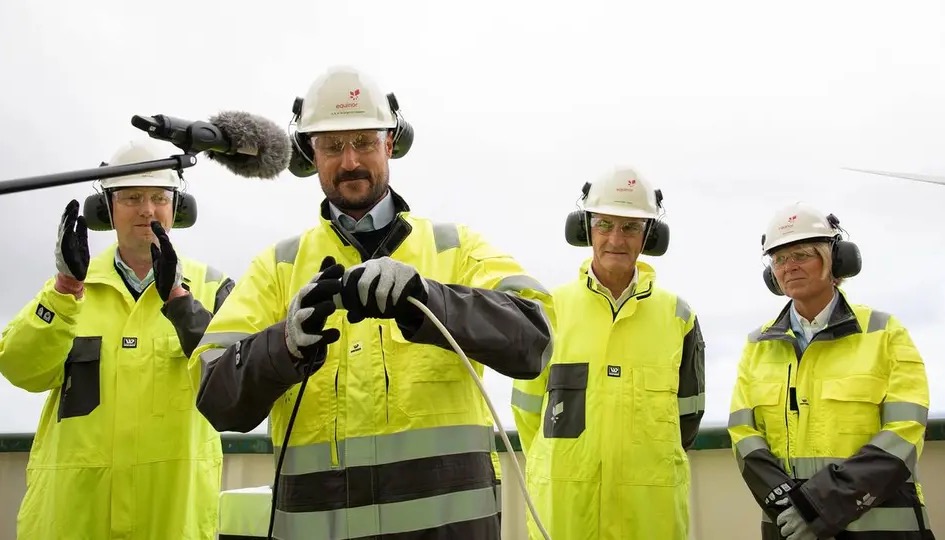
Equinor’s Hywind Tampen floating offshore wind farm has been officially opened by Crown Prince Haakon of Norway (pictured: second left).
The wind farm consists of 11 wind turbines based on the floating Hywind concept, developed by Equinor.
Hywind Tampen has a system capacity of 88MW and is expected to cover about 35 per cent of the annual need for electricity on Equinor’s five oil and gas platforms Snorre A and B and Gullfaks A, B and C.
The wind farm is managed from Equinor’s office location in Bergen.
Gullfaks and Snorre are the first oil and gas fields in the world to receive power from offshore wind, reducing CO2 emissions, Equinor said.
Kjetil Hove, executive vice president for the Norwegian continental shelf at Equinor said: “Hywind Tampen is expected to reduce CO2 emissions with 200,000 tonnes annually from key oil and gas producers in the North Sea.
“It is a bold investment in a pioneering project from the Gullfaks and Snorre partnerships and Enova.
“The project has given us and the supplier industry valuable experience that will be important when we work together to develop offshore wind further in Norway and globally, scaling up for the future.
“I would like to thank everyone who has contributed, this is an industrial development we can be proud of.”
In five years, the project has gone from the drawing board to completion, with 60% of the contract values in the project have been awarded to Norwegian suppliers, Equinor said.
This has contributed to new activity, green jobs, local spin-offs and technology development for future floating offshore wind projects in a growing industry, it added.
Enova and the Norwegian Business Sector’s NoX fund have supported the project with NOK2.3bnn and NOK566m respectively to stimulate technology development within offshore wind power and emission reductions.
The investment forecast for the project is now about NOK7.4bn.
When the plan for development and operation was submitted, the development cost was estimated at about NOK5bn.
The increase is due to a combination of COVID-related costs, delayed deliveries, quality issues with some deliveries and knock-on effects, Equinor said.
In addition, increased market prices, currency effects and supplier compensation for COVID-19 effects have contributed, it added.
At the same time, the expected CO2 tax and gas price have increased, which has a positive effect on the project economy.
The project has significant cost improvements compared to the Hywind Scotland floating offshore wind farm, which was the world’s first floating offshore wind farm, the developer said.
Adjusted for price developments since 2016/2017, the investment cost for Hywind Tampen is about 35% lower per installed MW, according to Equinor.