


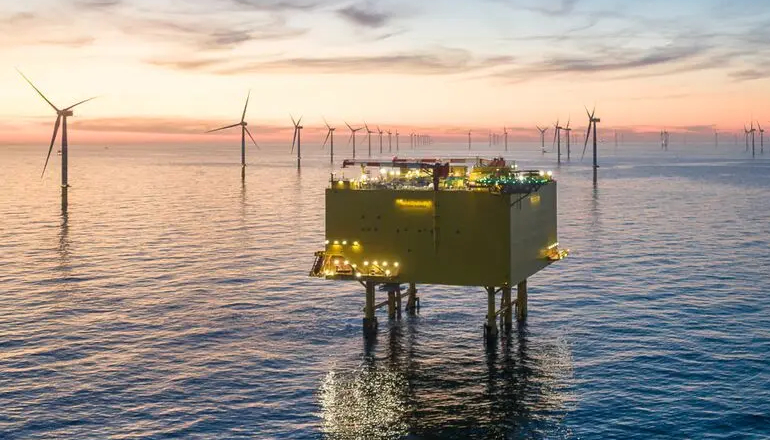
Statnett has entered into agreements with TenneT and other TSOs to cooperate on a cross border offshore grid in the North Sea linking clean electricity supplies in countries including Norway, Germany and Belgium.
Statnett has signed memorandums of understanding (MoU) with TenneT and with Amprion to explore the possibility of a hybrid interconnector that would connect both countries’ North Sea wind farms in parallel.
It has also signed an MoU with Elia for the hybrid interconnector link the two countries’ high voltage grids while also being connected to Norwegian offshore wind farms (making it a hybrid interconnector).
So-called hybrid interconnectors not only connect two countries directly with each other, but they also connect offshore wind farms.
This makes it possible to flexibly integrate wind energy into the European electricity system and to increase capacities for international electricity transport.
“A hybrid interconnector between the two countries would be another important milestone in achieving Europe’s climate targets and making better use of the North Sea’s wind energy potential.
“With the MoU, we are laying an important foundation for this,” said Hendrik Neumann, CTO of Amprion.
Tim Meyerjürgens, COO of TenneT, said: The MoU with Statnett is an important milestone for the cross border offshore grid in the North Sea.
“Only by jointly exploiting the potential of the North Sea can we achieve an efficient and robust offshore grid in the future.
“Our successful cooperation on NorNed and NordLink has shown that TenneT and Statnett are the right partners to drive forward pioneering projects.”
Statnett’s investigation work also cover the entire North Sea region and include Denmark, the UK and Belgium as possible alternative connection points in addition to Germany.
Meyerjürgens added: “This investigation can serve as a basis for a hybrid interconnector as an alternative grid solution for the announcement of new offshore wind farms on the Norwegian shelf that are planned in 2025.
“Germany is an interesting partner because of its already well-developed offshore capacities.
“TenneT is involved in the realisation of further hybrid interconnectors: TenneT is currently working with the UK’s National Grid on the LionLink, a link between the UK and the Netherlands.
“At the same time, TenneT is investigating international connections between the Netherlands and Belgium and between Germany and the Netherlands.
“A future cooperation with Statnett would complete TenneT’s portfolio in the North Sea and contribute to a European offshore grid.”
He also said that to deliver such a project, technical, regulatory and economic frameworks for a shared European offshore grid need to be quickly adapted to ensure that the first hybrid projects can be successfully commissioned in the 2030s.