


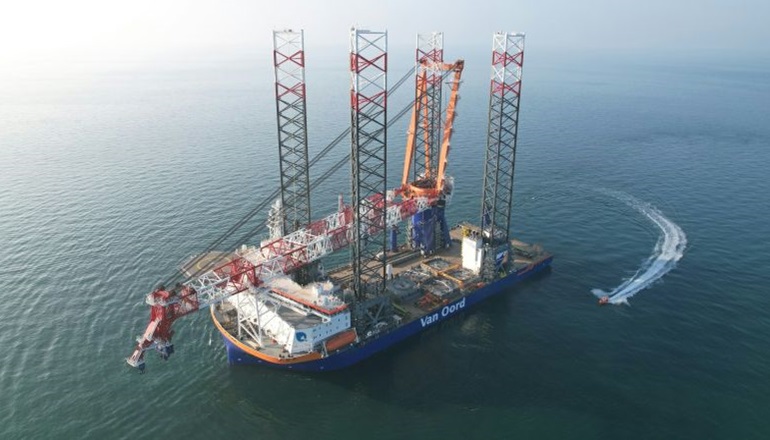
Van Oord’s Aeolus has installed the first monopile at RWE’s 1400MW Sofia offshore wind farm.
In the coming months, Van Oord will install a total of 100 monopiles on Dogger Bank in the central North Sea, 195km from the North East coast of the UK.
The offshore installation vessel Aeolus and crew will carry out work on three foundations per cycle, with a transit time of up to 16 hours.
The total duration of this campaign phase will depend on sea conditions, but all 100 monopiles are expected to be in place by spring 2025, following the installation of the high voltage direct current (HVDC) export cable which started during 2023.
Van Oord deployed its flexible fallpipe vessels Bravenes and Nordnes to work on scour protection at the locations where the monopiles are now being installed.
The foundations have a diameter of up to 8.8 metres, a length of up to 92 metres and a weight of up to 1530 tonnes.
They have been manufactured by EEW in Rostock, Germany and are transported by barges to the Port of Tyne.
This port serves as the storage and marshalling base for the turbine foundations and is located near Newcastle on the River Tyne in North East England.
The wind farm will use 100 Siemens Gamesa 14MW turbines (SG 14-222 DD), and is scheduled to be completed by the end of 2026.
A total of 44 of the project’s 100 machines will be equipped with recyclable blades.
RWE Offshore Wind chief executive Sven Utermohlen said: “Sofia is RWE’s largest offshore wind construction project to date, and its furthest from shore.
“Installing the first monopile is a highly symbolic moment in the construction of every offshore wind farm.
“After 14 years of planning and preparation, this is a great achievement for the entire RWE team.
“I would like to thank everyone involved for their contribution.
“Building a project of this size and scale is a great opportunity to demonstrate our expertise in delivering offshore wind energy around the globe.”
Van Oord project director Roeland Ris added: “We are very pleased to announce reaching this significant milestone.
“Following thorough preparations, offshore construction is now in full swing, driven by a high performing project team and great cooperation with all partners involved.”
For this site, so-called extended monopiles are used, eliminating the need for a transition piece.
To complete the foundations, the structures will be equipped with secondary steel components consisting of main access platforms, internal platforms, boat landings and upper ladders.
The secondary steel components have been manufactured by various suppliers in the Netherlands and Poland and are also transported to the Port of Tyne.
Later this year, Van Oord’s cable-laying vessel Calypso and trencher Dig-it will be deployed to install the 360km of array cables.
The wires have been manufactured in Greece and are stored in the Port of Blyth, which is located just north of Newcastle.