


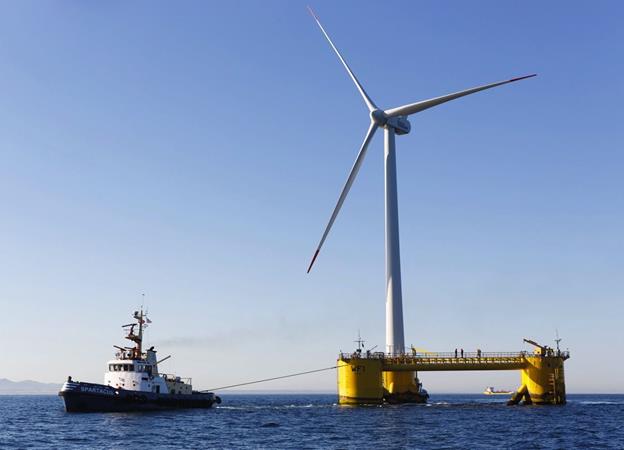
New floating wind research has found that for hypothetical minor repairs, strategies are likely to be similar to fixed-bottom far-shore sites.
The study on access and availability also found that floating turbine nacelle motions were not expected to be a significant problem with respect to motion-induced sea sickness.
These findings, released by the Floating Wind Joint Industry Programme (Floating Wind JIP), are part of the Stage 2 Phase 4 Summary Report, which provides a high-level overview of four key research projects delivered between 2020 and 2022.
The Floating Wind JIP is the Carbon Trust’s collaborative R&D programme, dedicated to overcoming technological challenges and advancing commercialisation of floating offshore wind.
The programme is a partnership between the Carbon Trust and 17 offshore wind developers.
With numerous commercial scale floating wind farms planned, but limited operational data due to the relative infancy of floating wind compared to its fixed bottom counterparts, the industry needs more information.
The research also covers an assessment of wind turbine generators for floating wind, numerical modelling guidelines and standards for floating wind, and an assessment of floating wind turbines’ impact on yield.
The assessment of wind turbine generators for floating wind farms project focused on understanding the differences in the load/motion envelope when moving from a fixed-bottom monopile to a floating foundation and the feasibility of delivering cost-effective soft-stiff designs.
This was followed by the numerical modelling guidelines project, which provided guidance for selecting and using numerical modelling tools for floating turbine design and detailed recommended load cases to reduce simulation efforts.
For optimal integrated modelling, wind turbine and floater designers should clarify how they will work together to couple software at the start of a project, the research concluded.
Finally, with limited operational performance data available, the impact of floating wind turbines on yield is not yet well understood or quantified, it also found.
The release of the Summary Report coincides with the announcement that all 17 participants of Floating Wind JIP: BP, EDF Renouvables, EnBW, Equinor, Kyuden Mirai Energy, Orsted, Ocean Winds, Parkwind, RWE Renewables, ScottishPower Renewables, Shell, SSE Renewables, TEPCO, Tohoku Electric Power Company, Total Energies, Vattenfall, and Wpd will be continuing into Stage 3, which will run from 2022 to 2026.
Carbon Trust head of floating offshore wind Sam Strivens said: “The past twelve months have seen a vast increase in floating wind activity.
“National targets were set at 6GW for the west coast of the United States and raised to 5GW by 2030 in the UK.
“Meanwhile floating specific tenders were underway in France, and pipeline projects were increased across Asia, totalling at least 25GW by 2035.
“The next challenge facing the floating offshore wind sector will be meeting this industrial demand.
“Collaboration, between regulators, windfarm developers and supply chain will be crucial to accelerate the commercial deployment of floating offshore wind and achieve Net Zero targets.”