


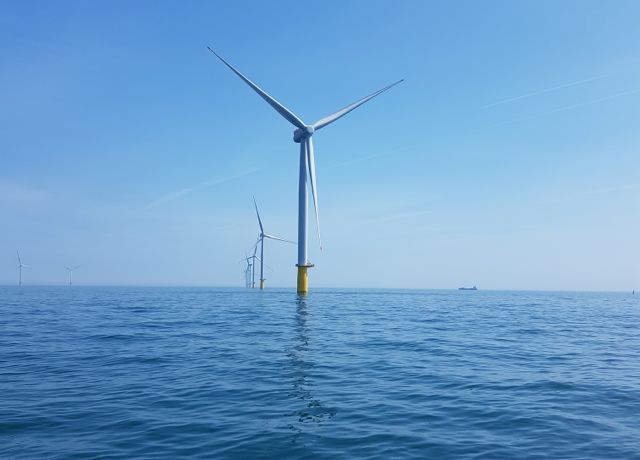
France will fail to meet its offshore wind installation target unless it streamlines permitting and creates a more favourable investment climate, according to new research.
Despite carrying out numerous tenders since 2011, France has just 1.5GW of operational offshore wind, the report from the Institute for Energy Economics and Financial Analysis (IEEFA) said.
Offshore wind technology provides just 1% of the country’s electricity, far below its northwest European neighbours.
The study found that unless it accelerates deployment, France might only have 3GW of operational offshore wind by 2032, leaving it off track to achieve the government’s target of 18GW by 2035.
This means the technology would play a limited role in replacing nuclear reactors due to be decommissioned, the report warned.
IEEFA power sector analyst and research author Jonathan Bruegel said: “A combination of complex permitting, legal challenges and focus on nuclear power have held back offshore wind development in France.
“There is a lack of political and financial support for offshore wind in France, which has struggled to provide the same level of certainty for investors as many other European countries.
“Action must be taken to turn the tide on French offshore wind development so that the technology can effectively strengthen the country’s energy security and help replace its ageing fleet of nuclear power plants, most of which will reach the end of their planned operational lifetimes by 2030.”
The research calls on France to urgently streamline offshore wind licensing and shorten the timeframe for legal challenges to projects awarded in tenders.
The report found that policy support for nuclear power has diverted financial resources away from renewables, potentially jeopardising the country’s energy security.
IEEFA recommends the development of a nuclear phase-down plan with offshore wind as a pillar.
When ageing nuclear plants are phased out, the government should create a structured transition plan that prioritises offshore wind and other renewables, IEEFA said.
The organisation also called on France’s transmission system operator to develop a modernised and more flexible grid that can handle intermittent renewables.
In addition, the country must reform market regulations and diversify energy investments, making offshore wind projects “more attractive” to investors through stable policies and incentives, IEEFA said.
“Unlocking the potential of France’s offshore wind resources will help the country succeed in its transition from a nuclear-dominated power mix to a more balanced system with significant levels of renewables,” Bruegel added.