


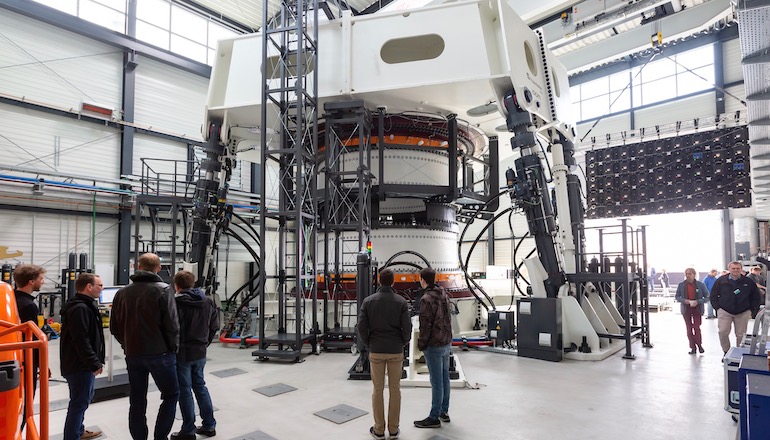
The first blade bearings have been put through their paces at a new test bench at the Fraunhofer IWES’s facilities in Hamburg, Germany.
Fraunhofer said the new BEAT 6.1 test bench will provide improved insight into damage and damage progression on wind turbine bearings.
The insights can be integrated directly into the design stage and, previously, were determined only through experience, it said.
“Optimised blade bearings help to prevent turbine downtimes and make turbine operation even more economic,” the organisation added.
The bench includes hybrid components that allows dynamic loads to be applied to the bearing.
The first test runs have been conducted and will be followed by others up until mid-August.
Fraunhofer said endurance tests for bearings for up to 10MW hardware will be carried out using complex data analyses to create time series that simulate various damage mechanisms.
“This makes it possible to test the resilience of bearings over their entire service life within just a few months prior to their installation in a wind turbine,” it said.
The goal is to simulate the loads that act on the 10-ton bearings during operation as realistically as possible, the institute added.
Rotor blade bearings measuring five metres in diameter from the Highly Accelerated Pitch Bearing Test research project have been tested.
The test series with function and fatigue tests will continue to run up to summer 2021.
Fraunhofer IWES managing director Andreas Reuter said: “The new test bench at the site in Hamburg bundles activities and also facilitates the experimental testing of bearings for the next generation of wind turbines.
“With the BEAT 6.1. test bench, Fraunhofer IWES has further enhanced its portfolio of validation services, which help turbine and component manufacturers to verify further and new developments prior to their market launch.”
The goal is to develop methods for the accelerated testing of blade bearings in cooperation with the research partners, the bearing manufacturer IMO, and the Institute of Machine Elements, Engineering Design, and Tribology at Leibniz University Hanover.
Following the test runs, the bench will be made open for use by all interested parties.