


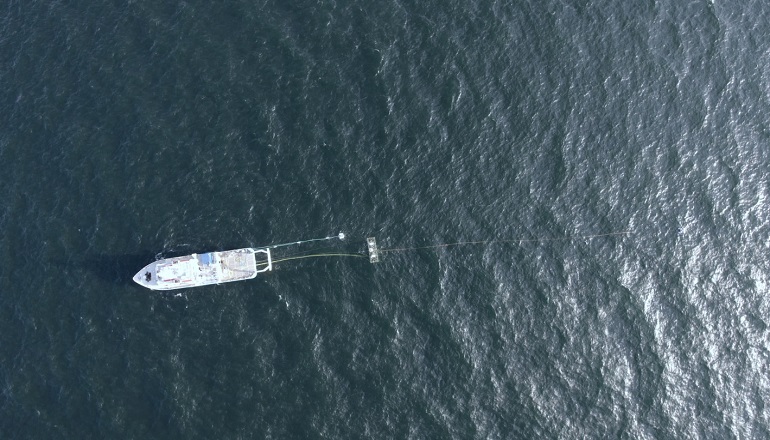
The Fraunhofer Institute for Wind Energy Systems IWES has completed a boulder detection campaign off the coast of the island of Rügen in the German Baltic Sea on behalf of 50Hertz.
To allow efficient planning of the grid operator’s new offshore platform, seismic measuring techniques have been employed to detect boulders up to 100 metres below the seafloor.
The technique used can enable more reliable planning of offshore wind farms and platforms, reducing costs and minimising risks associated with the installation of these projects.
The planning and installation of an offshore platform requires precise knowledge of the subsoil, as large rocks discovered too late can delay planning and construction, thus rendering the whole project more expensive.
Fraunhofer IWES employed the new method to check whether there were boulders in the subsurface of a wind farm area that had already been pre-surveyed for 50Hertz’s Ostwind 3 project.
With the aid of the patented Manta Ray G1, the IWES scientists could localise rocks and boulders at a depth of up to 100 metres below the seafloor.
The measuring system comprises a towed array equipped with seismic sensors (hydrophones) as well as positioning systems.
During the survey of an area, the hydrophones pick up the reflected sound waves previously emitted by a signal source.
This allows the subseafloor to be recorded step-by-step and mapped in three dimensions.
Not only does the measuring system map the sediment layers, but its design also enables the detection of boulders buried in the seafloor.
This is possible thanks to the method of diffraction imaging, through which the acoustic energy diffracted by the boulders can be traced back to its point of origin, allowing accurate localisation of rocks within the mapped seafloor sediments.
The detection on behalf of 50Hertz was performed within just one week aboard the survey vessel MV Situla.