


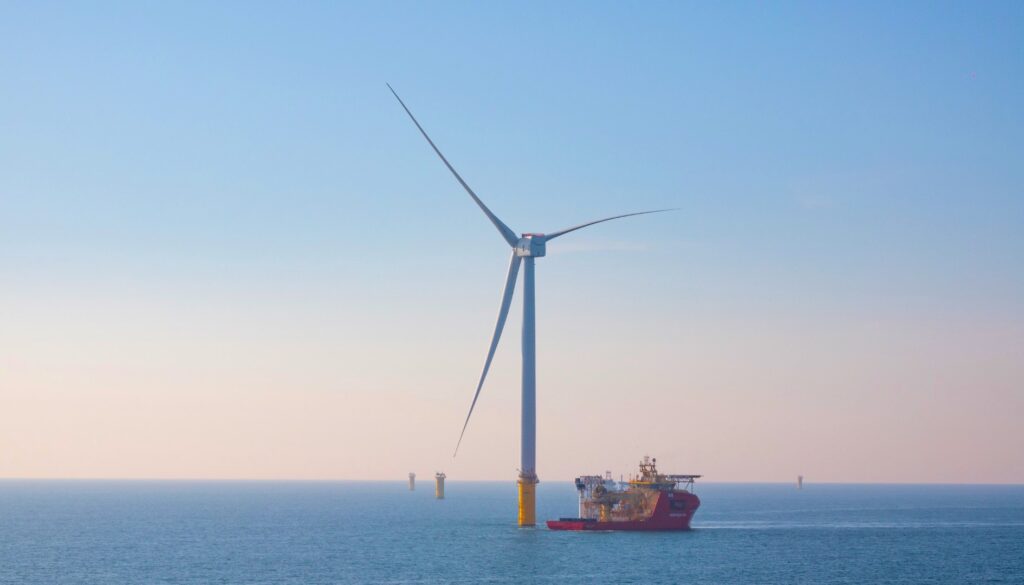
A GE Haliade-X turbine blade has failed at SSE Renewables, Equinor and Vargronn’s 1200MW Dogger Bank A offshore wind farm off east England, the second such incident to occur at the project.
The GE Vernova “blade failure” happened yesterday morning, according to the project developers.
No-one was in the vicinity when the incident happened.
“We are aware of a blade failure which occurred this morning on an installed turbine at Dogger Bank A offshore wind farm, which is currently under construction,” the developers said in a statement.
“In line with safety procedures, the surrounding marine area has been restricted and relevant authorities notified. No one was injured or in the vicinity at the time the damage was sustained.
“We are working closely with the turbine manufacturer, GE Vernova, which has initiated an investigation into the cause of the incident.”
In May, a blade that had previously been installed crumpled several metres away from the turbine hub, leaving the majority of the component dangling backwards over the nacelle in May, as revealed by subscriber-only reNEWS on 9 May. No one was injured.
An investigation found an issue during installation ultimately led to the failure.
GE Vernova told reNEWS at the time it was an “isolated blade event”.
Last month, a GE Haliade-X turbine blade failed at the under-construction 800MW Vineyard Wind project off the US north-east coast.
It forced the US company to launch a reinspection programme on up to 150 offshore blades manufactured at Gaspe in Canada, after determining a manufacturing fault was the cause of the incident.
The Vineyard failure was due to a “manufacturing deviation”, the company said during an investors call on 24 July.
GE Vernova’s chief executive Scott Strazik said at the time: “We have identified a material deviation, or a manufacturing deviation, in one of our factories that through the inspection or quality assurance process, we should have identified.”
He added that the company is going to use its existing data and “reinspect all of the blades that we have made for Offshore wind and for context in this factory in Gaspé, Canada where the material deviation existed”.
Strazik said the factory has made about 150 blades and referred to the use of non-destructive testing, like ultrasound, to identify deviations.
“We are going to go and do this on every blade, prudent, thorough process.
“We have work to do, but I have a high degree of confidence that we can do this, and we’ll do it in support of both the customer and the agency and move forward from there,” Strazik added.
He reiterated there were no indications of an engineering design flaw in the blade or information of a connection with the blade event experienced at the Dogger Bank offshore wind project in the UK, “which was caused by an installation error out at sea”.
GE Vernova has been contacted for comment.